
Reviewed · HISTORICAL TOURS
Private Vienna Highlights History Walk — WWII and Post War Vienna
Vienna’s grand center becomes more meaningful when you read it through the city’s wartime scars. This private walk links the Belvedere, the Soviet memorial, Heldenplatz, the Hofburg, Judenplatz, and St. Stephen’s Cathedral into one clear story of empire, Nazi rule, destruction, occupation, and the birth of modern Austria.
I like the private format, which lets your guide adjust the pace and answer the questions that matter to you. I also like the mix of walking and public transport. You see more ground in three hours without turning the experience into a bus ride.
The main drawback is the amount of material packed into a short time. You will see many important places, but most stops are outside visits rather than long museum sessions. Public transport fares, food, drinks, and the ride back to your hotel are not included.
Why this Vienna walk is different
- Belvedere opens the story with a view: The Upper Belvedere terrace connects Prince Eugene’s palace with Austria’s postwar return to independence.
- The Soviet memorial adds needed tension: The monument honors Red Army soldiers who helped end Nazi rule, while also recalling the Soviet occupation that followed.
- Hitler’s Anschluss speech took place at Heldenplatz: This is one of Vienna’s most important places for understanding the city’s political past.
- The tour reaches Vienna’s Jewish memorial: Judenplatz gives the Holocaust story a quiet, personal focus.
- Your guide can tailor the route: Walter, Brigitte, Alex, Andrea, Hannes, and Alexander Stollhof are among the guides praised for clear explanations, humor, and flexibility.
- You cover a lot without a large group: The tour is private for your party, with a maximum of 10 people.
From Belvedere gardens to the birth of the Second Republic
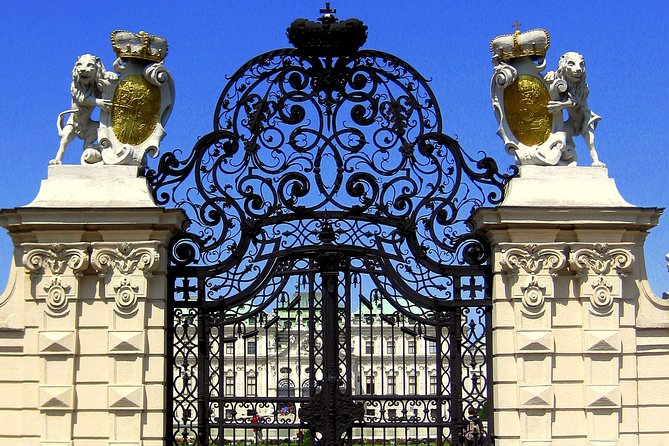
The tour begins at the Upper Belvedere, where Vienna opens out beneath you. Prince Eugene built this palace complex as a statement of wealth and military success, though he never ruled Austria. The terrace gives your guide a useful starting point for explaining how imperial power shaped the city.
The key postwar detail is the Austrian State Treaty of 1955. The treaty was signed at the Belvedere and helped restore Austria’s sovereignty after the years of Nazi rule and Allied occupation. The palace therefore links two very different ideas: imperial ambition and the modern republic’s policy of neutrality.
You then descend through the Belvedere Gardens toward the Lower Belvedere. The formal axis, carefully ordered terraces, and controlled views were designed to express rank and power. This is more than a pleasant garden walk. It shows how rulers used architecture and space to tell people where authority belonged.
The stop is listed as free, but it is mainly an exterior visit. If you want time inside the Belvedere galleries, especially to see the famous art collection, you would need a separate plan. That is not a flaw in this tour, but it matters if your main goal is museum time.
More history walks in Vienna:
- Vienna: Time Travel and Magic Vienna History Tour
★ 4.6 · 3,879 reviews - Vienna: World War II Historical Walking Tour
★ 4.8 · 1,772 reviews - Vienna Historic Center Small Group Walking Tour
★ 5.0 · 1,746 reviews
Schwarzenbergplatz and Vienna’s uneasy liberation
At Schwarzenbergplatz, the Soviet War Memorial brings the Second World War into the present. The monument honors Soviet soldiers who died in the 1945 battle for Vienna, when Nazi rule was brought to an end.
Your guide can help you hold two facts together. The Red Army helped defeat Nazism, and Soviet forces then remained in Austria as an occupying power. Vienna’s memory of 1945 is not a simple story of rescue. Liberation and occupation sit side by side, and this stop makes that tension visible.
Nearby, the Hochstrahlbrunnen and the French Embassy provide a change of tone. The fountain celebrates Vienna’s alpine water supply, while the embassy adds a formal French architectural presence. Together, the two buildings reflect different Allied influences in postwar Vienna.
A short tram ride along the Ringstraße follows. This is a practical part of the route, not wasted time. You pass grand public buildings and approach the historic center in the same way many residents do. Your guide can also help you understand how the Ringstraße became Vienna’s great nineteenth-century showcase.
Public transport is not included in the price, so bring a way to pay for your tram or other rides. The exact transport sequence may shift with your interests and the day’s conditions.
Burggarten and the complicated story of culture
Burggarten once belonged to the imperial court. Today, the Mozart monument gives the garden a familiar musical face, but the nearby Academy of Fine Arts adds a darker historical detail.
The academy famously rejected Adolf Hitler when he applied to study art. That fact is often repeated because later events made it seem prophetic, but your guide can place it in context rather than treating it as a tidy explanation for Nazism. It is a small detail with an outsized place in popular memory.
This stop is brief, around five minutes in the planned schedule. You should expect an outdoor explanation and a quick look, not an extended visit to the academy.
Maria Theresa, the flak tower, and the cost of total war
At Maria Theresa Square, the empress faces the twin museums across a broad formal space. The setting shows Vienna at its imperial best: carefully planned, ceremonial, and meant to impress.
Then look beyond the elegant façades for one of Vienna’s flak towers. These huge concrete anti-aircraft structures were built during the Second World War and are difficult to remove. They remain as blunt reminders of the city’s militarized final months.
The contrast is powerful. Maria Theresa’s square represents dynastic ceremony and cultural confidence. The flak tower represents fear, air raids, and a regime preparing for total war. This is one of the best moments on the route for seeing how Vienna’s polished center can conceal hard evidence of the twentieth century.
You will not spend long at the square, so listen closely. The scheduled stop is about 10 minutes, enough for orientation and photographs, but not enough for a full museum visit.
More walking tours in Vienna:
- Vienna: Guided Walking Tour of City Center Highlights
★ 4.7 · 4,989 reviews - Vienna: Vienna Central Cemetery Guided Walking Tour
★ 4.8 · 3,307 reviews - Vienna: Guided Walking Tour of City Highlights & Hidden Gems
★ 4.9 · 2,180 reviews - Vienna: Viennese Underworld Guided Walking Tour
★ 4.7 · 1,865 reviews
Heldenplatz and the danger of political theater
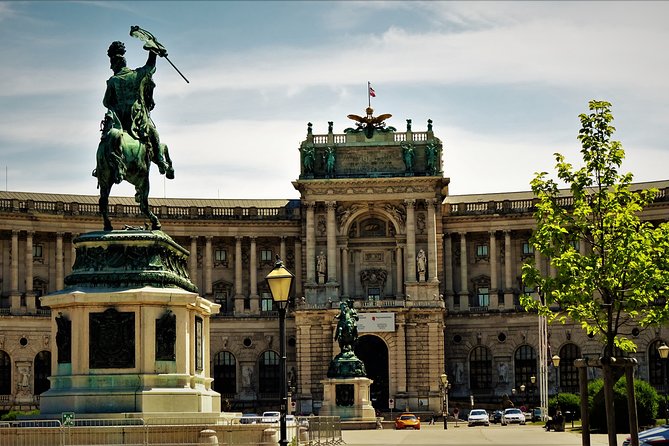
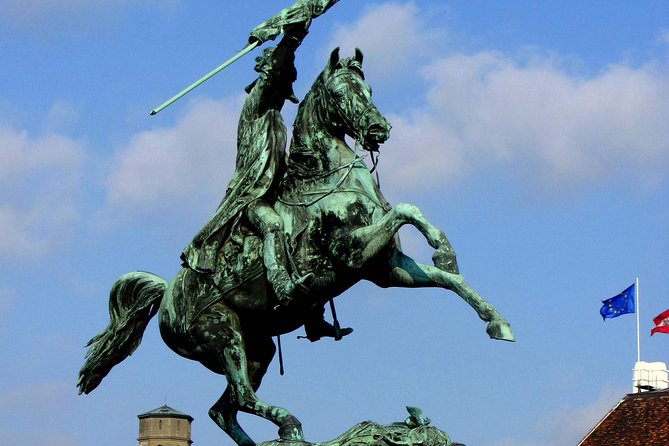
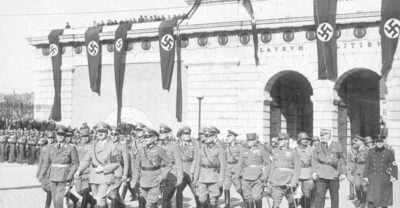
Heldenplatz is one of the essential stops. It was designed for imperial ceremony and military display, then became the setting for Adolf Hitler’s March 1938 speech celebrating the Anschluss, Nazi Germany’s annexation of Austria.
The broad open space makes the political message easy to understand. It was built to frame power in public, and its scale still gives speeches and ceremonies a dramatic stage. Your guide can explain how a place created for imperial pride was repurposed by the Nazi regime.
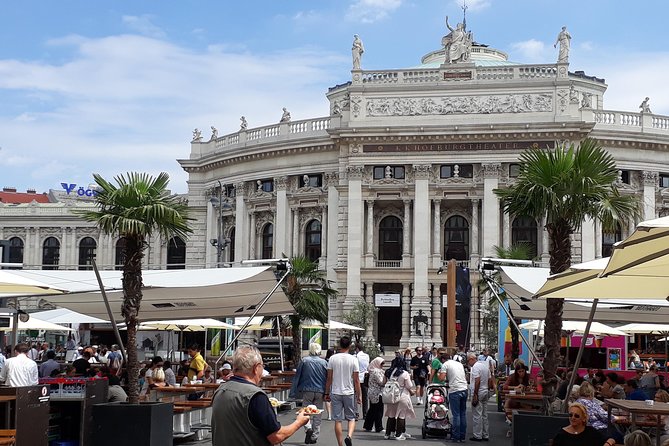
The surrounding view brings several kinds of authority together: parliament, city hall, museums, and the Burgtheater. This is not simply a collection of impressive buildings. It is a compact lesson in how governments, culture, and public memory share the same streets.
The scheduled visit lasts about 15 minutes. It is enough to grasp the setting and its importance, but you should not expect a long discussion of every building around the square.
The Hofburg and Vienna’s long transfer of power
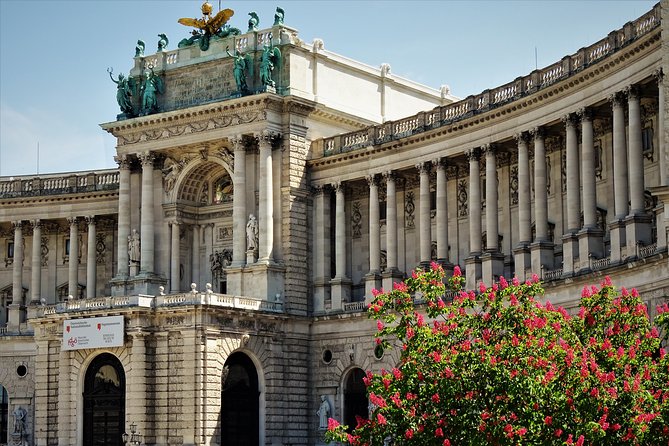
The Hofburg is a palace complex rather than one single building. It served as the seat of power for roughly seven centuries, first for dukes and later for emperors. Today, it is connected with Austria’s modern presidency.
That long use gives the Hofburg a useful place in this tour. You can trace the shift from hereditary monarchy to republic without leaving the center of Vienna. The architecture still speaks in the language of empire, while the institution using part of the complex belongs to a different political system.
The route also passes a part of central Vienna where imperial façades meet churches, shops, and luxury boutiques. That mix is worth noticing. Vienna’s identity has always included ceremony, commerce, and religious life, often within a few minutes of one another.
The Hofburg visit is another exterior-focused stop. If you want the Imperial Apartments, the Sisi Museum, or the Spanish Riding School, plan those separately. The private walk gives you the framework so those attractions make more sense later.
Judenplatz and the Nameless Library
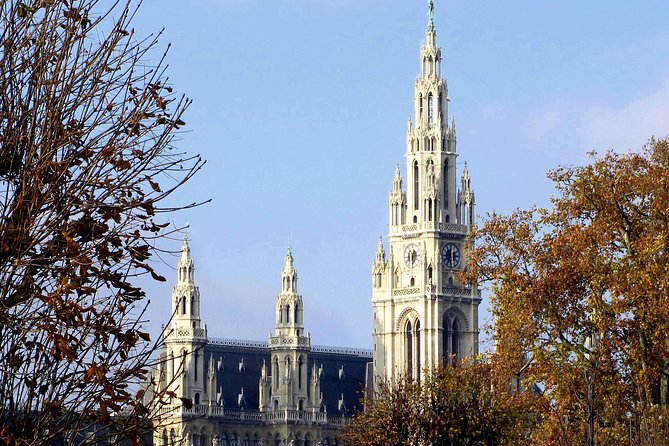
Judenplatz is the quietest and most serious stop on the route. The square occupies the site of Vienna’s medieval Jewish community, which was destroyed in 1421. The Holocaust Memorial, often called the Nameless Library, commemorates the 65,000 Austrian Jews murdered in the Shoah.
The memorial’s closed shelves suggest books that cannot be opened, and lives that cannot be restored. It is a restrained work in a busy central district, so the guide’s explanation matters. This is a place to slow down, listen, and give the subject the attention it deserves.
Judenplatz also helps correct a common mistake in city sightseeing. Vienna’s Jewish history did not begin or end with the twentieth century. The square points to medieval persecution as well as the Holocaust, showing that the city’s Jewish past reaches far back and includes repeated periods of loss.
The stop lasts about 15 minutes. That is enough for a meaningful introduction, though anyone wanting a longer visit should return on their own.
The Plague Column and St. Stephen’s Cathedral
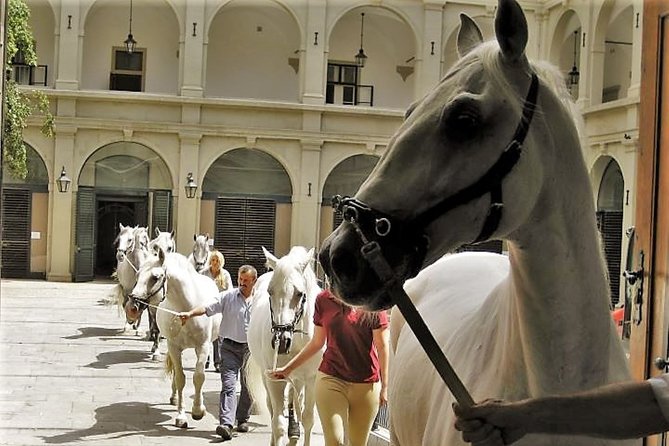
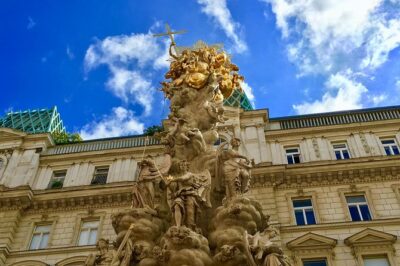
The Plague Column, or Pestsäule, brings the tour back to an earlier crisis. Its elaborate marble form reflects the Counter-Reformation and Vienna’s attempt to express faith and recovery after plague. It is a reminder that the city faced severe danger long before the twentieth century.
The monument is also a good example of Vienna’s habit of turning public squares into statements. The column is devotional, political, and theatrical at once. A quick stop gives you the basic story, while a closer look rewards attention to its crowded sculptural details.
At St. Stephen’s Cathedral, you reach Vienna’s Gothic center. The cathedral has long served as one of the city’s main symbols, but the wartime story here is not only about bombing. In April 1945, parts of the building burned after looters set fire to nearby shops.
That detail gives the final stop a grim immediacy. The war had already devastated the city, and the cathedral suffered during the collapse of Nazi rule. The stop is scheduled for about 10 minutes and focuses on the exterior and the cathedral’s place in Vienna’s story. You can arrange a separate interior visit if you want more time.
What the private format adds
The strongest part of this experience is the guide. Walter is repeatedly praised for fitting a great deal into three hours while keeping the pace lively. He is also comfortable with subways, trams, and trains, which is useful when the route needs to cover both the Belvedere and the old center.
Brigitte is known for a warm, personal approach and for adjusting plans around questions and interests. Alex is described as entertaining and willing to chase down an answer. Andrea is valued for giving a clear overview, while Hannes and Alexander Stollhof have also led flexible, well-received walks.
Those individual names matter because this is not an audio guide or fixed group script. Your experience depends partly on the guide assigned to your date. The company’s team includes licensed Austria Guides, and the format allows you to discuss food, museums, architecture, or later plans as you walk.
Past experiences also show how the private setup can help with practical problems. Brigitte has helped arrange a Christmas Day meal and accompanied a party on the subway so they could find the route back to their hotel. Those are not guaranteed features, but they show the kind of local help a private guide may provide.
Price, timing, and who gets good value
The price is $342.40 for a private group of up to 10 people. For one or two people, that is a serious expense. For a family or group of friends, the per-person cost becomes much easier to justify, especially since you receive three hours with a licensed guide rather than sharing attention with a large group.
Pickup is offered from hotels, vacation rentals, Vienna Central Station, Vienna West Station, and the Reichsbrücke pier. A start at 9:30 or 14:00 gives you a useful choice for fitting the walk around a train arrival, a cruise schedule, or another attraction.
Hotel drop-off is not included. Food, drinks, and public transport fares are also extra. The tour requires moderate physical fitness, since you will walk between several central sights and use city transport. Service animals are allowed, but pets may not be permitted in some places along the route.
I would book well ahead for a specific date. This experience is booked an average of 47 days in advance, which suggests that popular times may fill early. Confirmation is sent within 48 hours, subject to availability, and cancellation is free up to 24 hours before the start time.
Should you book this Vienna history walk?
Book it if you want a fast but serious introduction to Vienna’s twentieth-century story, especially if you are in the city for only a short stay. It suits first-time visitors, families, cruise stopovers, and anyone who wants a guide to connect grand buildings with difficult events.
It is also a good choice for a group that values conversation and flexibility. Walter, Brigitte, Alex, Andrea, Hannes, or Alexander Stollhof may bring different personalities, but the guide-led format is the main advantage.
Skip it if you want long indoor visits, extensive art viewing, or a slow architectural study. The route covers a lot in three hours, and the main value comes from the explanations, connections, and local orientation.
For a compact introduction to Vienna’s imperial center, Nazi past, Jewish history, Soviet occupation, and postwar republic, I find the price reasonable for a full private group. Just bring comfortable shoes, allow extra money for transport, and treat this as a strong first look rather than the last word on the city.
FAQ
How long does the Vienna history walk last?
The experience lasts approximately three hours.
What time does the tour start?
The available start times are 9:30 and 14:00.
Can the guide pick me up at my hotel?
Yes. Pickup is offered from hotels and vacation rentals in Vienna. Pickup can also be arranged from Vienna Central Station, Vienna West Station, the Reichsbrücke pier, and other agreed locations.
How many people can join the private tour?
The price covers one private group of up to 10 people.
Is public transportation included?
No. Public transport to and from the attractions is not included. The route may use a short tram ride and other city transport, so you should budget for those fares.
Are food and drinks included?
No. Food and drinks are not included.
Does the tour include hotel drop-off?
No. Hotel drop-off is not included, though the guide can help you understand the public transport route back.
Can I cancel for a full refund?
Yes, if you cancel at least 24 hours before the local start time. Cancellations or changes made less than 24 hours before the start are not refunded or accepted.
Just reviewed in Vienna
- World War II History Vienna Old Town Private Walking Tour★ 4.8 · 9 reviews
- Vienna: Wine Tasting E-Bike Tour★ 4.9 · 46 reviews
- Vienna: Winery and Wine Tasting Tour with a Wine Expert★ 5.0 · 5 reviews
- Vienna: Unforgettable Private City Tour★ 5.0 · 7 reviews
- Vienna Urban Art Tour: Explore a different side of Vienna!★ 3.8 · 14 reviews
- Vienna: Concert by the Vienna Baroque Orchestra★ 4.6 · 56 reviews
- Vienna: Sunday Brunch Danube Cruise & Live Music★ 4.2 · 42 reviews
- Vienna Supreme Orchestra at Palais Niederösterreich★ 4.8 · 10 reviews
Historical Tours, compared.
Vienna Historic Center Small Group Walking Tour
Read our review →
Time Travel-Magic Vienna History Tour Ticket
Read our review →
Skip-the-Line Schonbrunn Palace Guided Tour and Vienna Historical City Tour
Read our review →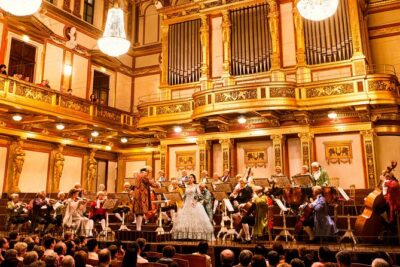
Vienna Mozart Concert in Historical Costumes at the Musikverein
Read our review →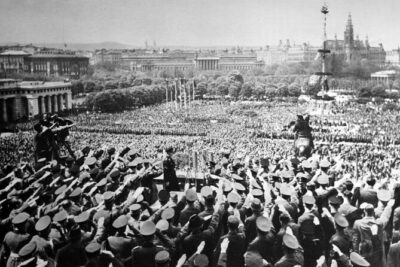
Historical Hitler Walking Tour of Vienna
Read our review →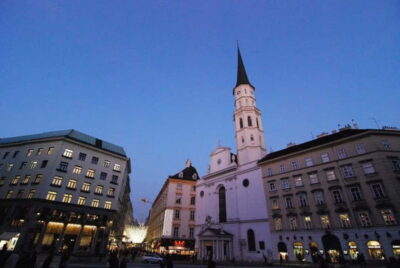
Browse the lists this tour appears in