
Reviewed · WALKING TOURS
Walking Tours for Time Travelers
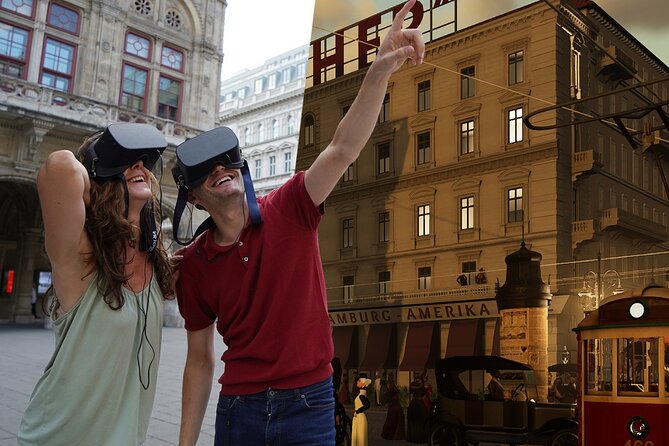
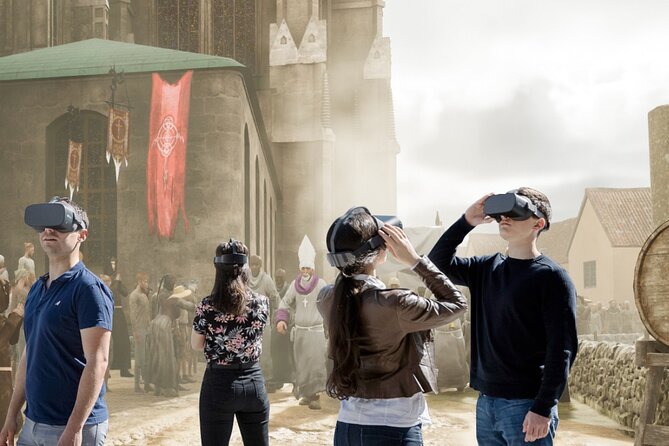
Vienna’s Old Town becomes a time machine on this two-hour walk. At key sights, you put on VR glasses and watch earlier versions of the city appear in 360-degree animation, while an English audio guide explains what you’re seeing. It is a smart way to connect today’s grand streets with the people and events that shaped them.
I like the small seven-person limit, which keeps the walk from feeling like a parade. I also like the modest walking distance, about 2 to 3 kilometers, paired with stops at Vienna’s biggest central landmarks. The main consideration is that this is not suitable for children under 10 or people with epilepsy, and the VR element may not appeal to everyone.
Key points at a glance
- VR at five central Vienna sights: See historical scenes at St. Stephen’s Cathedral, Graben, Hofburg, the Opera, and Stephansplatz.
- A gentle 2 to 3 kilometer route: The walk lasts about two hours, so you get a useful Old Town introduction without a strenuous hike.
- English audio guidance: The narration explains the stages of Vienna’s development as you move between landmarks.
- Maximum of seven people: The small group size gives the experience a more personal feel.
- $47.17 per person: The price pays for both the guided walk and the VR equipment, making value depend on how much you enjoy interactive history.
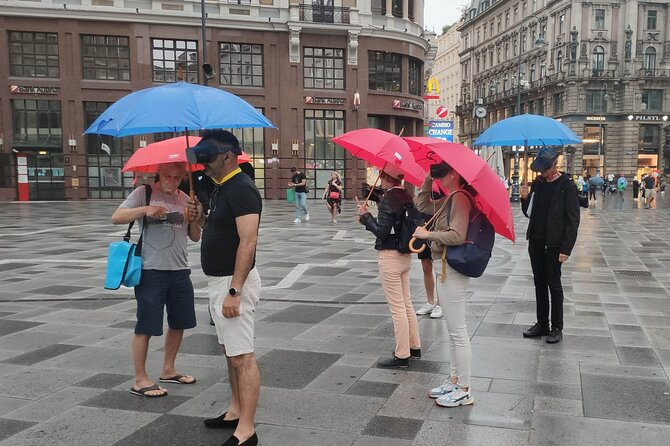
- Weather matters: The activity requires good weather, with a new date or full refund offered if poor conditions cause cancellation.
Vienna’s past appears at street level
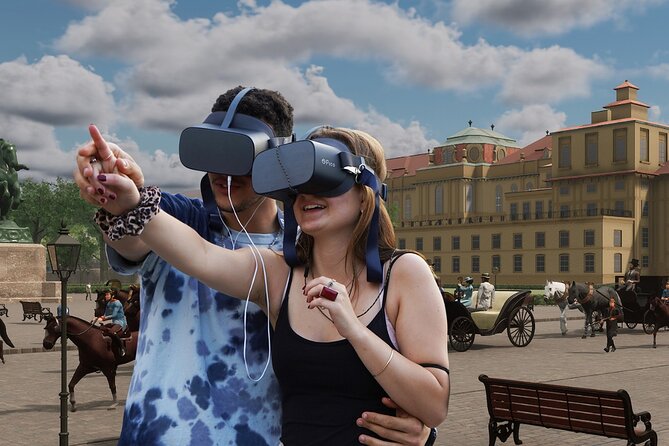
The clever idea here is simple: you do not study old Vienna only through dates and stone buildings. You stand in the modern city, look at a landmark, and then use VR to see how that same place looked or functioned in another period.
That contrast can help you notice details you might otherwise walk past. A church, palace, square, or opera house becomes more than a photo stop. The audio guide gives you the setting, while the animated scene supplies a visual bridge between past and present.
This format works especially well in Vienna because the Old Town packs major sights into a walkable area. You are not spending half the tour on buses or long transfers. The route starts at Johannesgasse 21 and finishes at Stephansplatz, keeping the experience focused on the central district.
The VR is not the only reason to book. One person found the walk and audio explanation useful even without prior VR experience, and that is important if you are unsure about the technology. You can still gain value from the route, the commentary, and the landmarks themselves.
More walking tours in Vienna:
- Vienna: Guided Walking Tour of City Center Highlights
★ 4.7 · 4,989 reviews - Vienna: Vienna Central Cemetery Guided Walking Tour
★ 4.8 · 3,307 reviews - Vienna: Guided Walking Tour of City Highlights & Hidden Gems
★ 4.9 · 2,180 reviews
Starting at Johannesgasse 21
The meeting point is the tour office at Johannesgasse 21 in Vienna’s 1010 district. From there, the group begins on foot, with the route moving through the Old Town toward Stephansplatz.
The small group limit matters right away. With no more than seven people, you should have a better chance of hearing the audio instructions and getting help with the equipment than you would on a large city tour. It also makes the pace easier to manage.
The tour is offered in English. Confirmation arrives at booking, and the meeting point is near public transportation, which makes it practical to reach from elsewhere in central Vienna. Plan to arrive with enough time to find Johannesgasse 21, since the tour itself is built around a fixed sequence of stops.
The activity averages about two hours. The walking distance is roughly 2 to 3 kilometers, so I would call it an easy city walk rather than a physical sightseeing challenge. Comfortable shoes still make sense, since the route runs over city streets and public squares.
St. Stephen’s Cathedral and the first VR scene
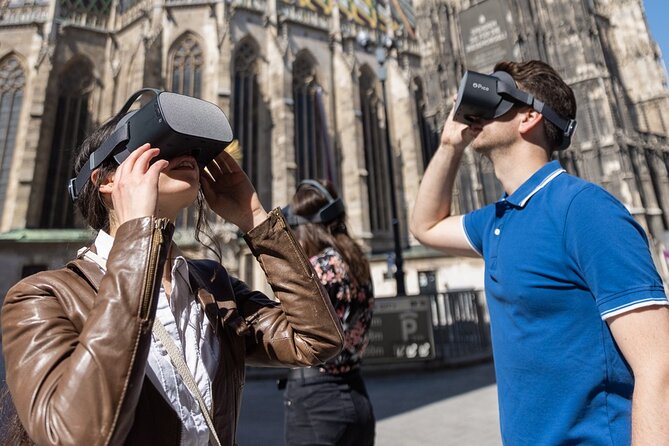
St. Stephen’s Cathedral, or Stephansdom, is one of Vienna’s essential sights. Its patterned roof and tall Gothic form make it easy to recognize, but a present-day view only tells part of the story.
Here, the VR scene gives you a look at an earlier stage of the cathedral and its surroundings. The value is in seeing change in place, not in isolation. You are looking at the real building, then comparing it with a reconstructed moment from the past.
The visual effect can be especially useful if you have never used VR before. The scene is designed to be viewed at a landmark rather than inside a dark theater, so the historic setting remains part of the experience. An audio guide continues to explain what you are seeing and how Vienna developed around the site.
You should expect a stop that combines one of the city’s best-known buildings with the tour’s main technology. If you want time for detailed interior sightseeing, this walk may not be enough by itself. The focus is on the guided route and the VR scene, not on a full cathedral visit.
Graben connects grand architecture with daily life
From the cathedral area, the route reaches Graben, one of central Vienna’s most recognizable streets. It is a useful place for the tour because it shows how the Old Town works as a public space, not just as a collection of monuments.
The audio commentary helps place the street in the wider story of Vienna. The VR scene then gives you a visual sense of how the area changed over time. This is where the experience can help you read the city more carefully. Instead of seeing only shops, paving, statues, and façades, you get a sense of earlier activity in the same setting.
The walk between stops is part of the product. You are not simply transported from one attraction to another. The audio guide talks you through the stages of Vienna’s evolution as you move, which gives the route a clear narrative.
The drawback is that audio guidance can feel less personal than a live guide who answers questions as you go. The small group softens that issue, but the experience remains partly self-guided through recorded narration. If you strongly prefer conversation and spontaneous questions, keep that difference in mind.
A different sort of day out in Vienna:
- Vienna: Vivaldi’s Four Seasons Concert in Karlskirche
★ 4.7 · 14,951 reviews - Vienna: Skip-the-cashier-desk-line Giant Ferris Wheel Ride
★ 4.5 · 7,859 reviews - Vienna: Schönbrunn Palace & Gardens Skip-the-Line Tour
★ 4.7 · 7,739 reviews - Vienna: Light of Creation Votive Church Immersive Light Show
★ 4.8 · 6,779 reviews
Hofburg reveals Vienna’s imperial center
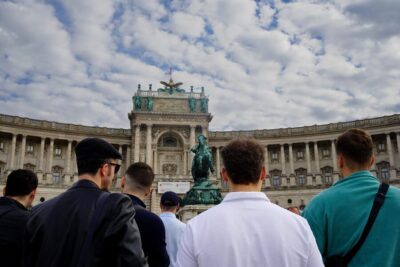
The Hofburg is the route’s most obvious reminder of Vienna’s former imperial power. The complex is large, and a short walk cannot cover every courtyard, wing, or collection. Instead, this stop gives you a focused look at the role the Hofburg played in the city.
The VR animation adds scale and context. Historic buildings often change in ways that are hard to understand from a single modern façade. Seeing an earlier scene at the site can show how the area functioned before later changes altered its appearance.
This is also a good point in the tour for the audio guide to connect landmarks rather than treat them as separate attractions. St. Stephen’s Cathedral, Graben, and the Hofburg are close together, but each represents a different side of the city. The route links them into one story.
You should not expect a full palace tour here. The supplied information describes a walking tour with VR scenes at selected points, not entry to the Hofburg’s museums or rooms. If you want palace interiors, you would need to arrange that separately and allow extra time.
The Opera stop adds a modern cultural note
The Vienna Opera stop shifts the mood from cathedral and palace to performance and public culture. The Opera is one of the city’s signature buildings, and it gives the tour another way to show how Vienna’s identity developed.
The stop uses the same basic pattern: arrive at the landmark, listen to the audio explanation, and view a VR scene connected with the past. That repeated structure makes the walk easy to follow. You know what to expect at each major point, but the setting changes enough to keep the route from feeling like one long equipment demonstration.
The Opera is also a useful reminder that Vienna’s story is not limited to rulers and formal architecture. Music and performance are central to the city’s public image, and the stop broadens the route beyond churches and palaces.
Again, the tour does not promise entry into the Opera. You are viewing the exterior setting and its associated VR material during the walk. If you want a concert, performance, or interior visit, this activity is not a substitute.
Finishing at Stephansplatz
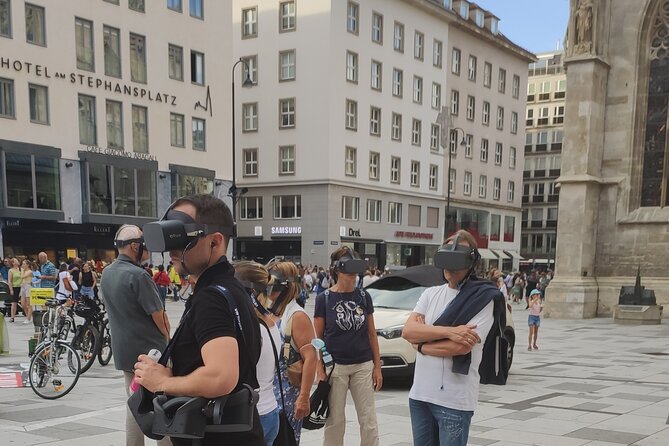
The tour ends at Stephansplatz, the open square beside St. Stephen’s Cathedral. Ending here is practical because you finish in one of central Vienna’s easiest places from which to continue sightseeing.
You can treat the final stop as a recap of the route. The cathedral, Graben, Hofburg, and Opera have all been connected by the audio narrative and the VR scenes. By the end, you should have a better sense of how the modern Old Town grew out of earlier layers.
The finish also gives you flexibility. Since the tour lasts about two hours, you still have much of the day available for lunch, museums, shopping, or a return visit to a landmark that caught your attention. The route is compact enough that you can use the tour as an orientation walk early in your Vienna stay.
The experience is not built around long free periods at each sight. If you want to linger for photographs or explore every building in detail, you may need to return afterward. Think of this as a structured introduction, not a complete Old Town visit.
What the $47.17 price really buys
At $47.17 per person, the price is higher than a basic self-guided walk through Vienna. You are paying for more than the route itself: the audio content, VR equipment, historical animation, and small group format all form part of the package.
The value is strongest if you enjoy learning through images. A normal walking tour can explain that a place looked different in the past. Here, the VR scenes try to show you that change directly, in 360-degree animation at the actual landmark.
The price also makes more sense for first-time VR users who want a short, structured introduction rather than a full entertainment session. The walking distance is manageable, and the experience uses the city itself as the setting.
It is less compelling if you mainly want a live historian, long discussions, or entry to Vienna’s interiors. The tour does not include a full palace visit, cathedral tour, or Opera performance. You are buying a compact technology-assisted city walk, and its worth depends on how much that format appeals to you.
The rating is 4.7 from 93 recorded ratings, with 94 percent recommending the experience. Those figures suggest a strong level of satisfaction, but they should not hide the practical limits: this is a short route, an English audio experience, and a VR activity with health restrictions.
Who should book this Vienna walk
I would suggest it to first-time visitors who want a quick orientation to the Old Town with more visual context than a standard stroll. It also fits people who enjoy trying new technology but do not want to spend a full day inside a VR attraction.
The tour suits couples and small groups particularly well. The seven-person cap keeps the setting intimate, and the two-hour length leaves room for other plans. One especially useful detail is that the experience can still work for someone who has never used VR before.
Families need to check the age rule carefully. Children under 10 are not suitable for the tour, and the activity is not suitable for people with epilepsy. Service animals are allowed, and most people can take part, but anyone with a specific concern should consider the VR format before booking.
The weather rule also affects planning. This is an outdoor walk, so poor weather can lead to a new date or a full refund. You can cancel for a full refund up to 24 hours before the start time, but cancellations or changes made inside that window are not refunded or accepted.
Practical planning before you go
The experience is offered in English only, so you should be comfortable following spoken English through an audio guide. The supplied information does not name an individual guide, and the format relies on recorded explanations alongside the VR scenes.
Book ahead if your Vienna schedule is fixed. The experience is booked, on average, 24 days in advance, and the seven-person limit means spaces are naturally limited. That does not guarantee that every date sells out, but it is a good reason not to leave a preferred morning or afternoon until the last minute.
Wear shoes suitable for 2 to 3 kilometers of city walking. The route is not described as strenuous, but you will be on your feet for about two hours. Since the activity depends on good weather, check the forecast and keep some flexibility in your itinerary.
Allow time to reach Johannesgasse 21 in the 1010 district. The end at Stephansplatz is central and convenient, but the start and finish are different points. That is helpful for sightseeing, since you do not need to return to the office after the tour.
Should you book Walking Tours for Time Travelers?
Book it if you want Vienna’s central sights explained through a blend of walking, audio, and 360-degree VR scenes. The route is short, the group is capped at seven, and the sequence from Johannesgasse to Stephansplatz gives you a useful first look at the Old Town.
Skip it if you want a traditional live guide, extensive interior visits, or a long and detailed architectural tour. At $47.17, the experience earns its price through the technology and small group size, not through museum admission.
For most suitable participants, this is a practical two-hour introduction with a clear purpose: help you see Vienna’s present streets alongside its past. If that idea sounds more useful than another ordinary walking loop, it is worth booking ahead.
FAQ
How long does the Vienna VR walking tour last?
The tour lasts approximately two hours.
How far do you walk?
The total walking distance is about 2 to 3 kilometers.
Where does the tour start?
The meeting point is Johannesgasse 21, 1010 Wien, Austria.
Where does the tour end?
The tour finishes at Stephansplatz in Vienna’s 1010 district.
Which sights are included?
The VR scenes take place at St. Stephen’s Cathedral, Graben, Hofburg, the Opera, and Stephansplatz.
Is the tour offered in English?
Yes. The experience is offered in English, including the audio guide.
How many people can join the tour?
The maximum group size is seven people.
Is the tour suitable for children and people with epilepsy?
The experience is not suitable for children under 10 or for people with epilepsy. Service animals are allowed, and most people can participate.
Can I cancel for a refund?
Yes. You can cancel at least 24 hours before the start time for a full refund. Changes or cancellations made less than 24 hours before the start time are not accepted or refunded. If poor weather causes the tour to be canceled, you will be offered another date or a full refund.
Just reviewed in Vienna
- World War II History Vienna Old Town Private Walking Tour★ 4.8 · 9 reviews
- Vienna: Wine Tasting E-Bike Tour★ 4.9 · 46 reviews
- Vienna: Winery and Wine Tasting Tour with a Wine Expert★ 5.0 · 5 reviews
- Vienna: Unforgettable Private City Tour★ 5.0 · 7 reviews
- Vienna Urban Art Tour: Explore a different side of Vienna!★ 3.8 · 14 reviews
- Vienna: Concert by the Vienna Baroque Orchestra★ 4.6 · 56 reviews
- Vienna: Sunday Brunch Danube Cruise & Live Music★ 4.2 · 42 reviews
- Vienna Supreme Orchestra at Palais Niederösterreich★ 4.8 · 10 reviews
Walking Tours, compared.
Guided Walking Tour of City Highlights & Hidden Gems
Read our review →
Vienna Historic Center Small Group Walking Tour
Read our review →
Browse the lists this tour appears in