Reviewed · TOURS
Alternative Tour in Vienna Off the tourist track
Vienna’s grand palaces and coffeehouses tell only part of the story. This two-hour walking tour with Martin looks at the city through the eyes of someone who once lived on its streets, offering personal accounts of homelessness, drug addiction, squatting, and punk life. It is direct, sometimes funny, often difficult, and far removed from the usual sightseeing circuit.
I like the honest personal viewpoint and the way the tour connects social issues to real streets and public places. I also like its manageable length, its limited group size of 20, and the chance to ask Martin questions as you walk. The main consideration is its subject matter: stories about addiction, eviction, and life without stable housing can be upsetting, so this is not a light city stroll.
Key points to know
- Martin’s personal story: Your guide once lived on the streets and speaks openly about homelessness and drug addiction.
- A different route through Vienna: The walk begins at Karlsplatz, passes the Secession, and ends near Haus des Meeres in Esterhazypark.
- Two meaningful stops: Alfred-Grünwald-Park and Ilse-Pisk-Stiege provide the setting for personal stories and local social history.
- The Anarchia eviction: Martin explains the dramatic evacuation of a squatted pizzeria occupied by 19 people and cleared by 1,700 police officers.
- Small-group feel: The tour accepts no more than 20 people, which matters when the guide is discussing personal and sensitive subjects.
- Good for students and adults: The clear format and open question time make it suitable for teenagers, school groups, and adults who want more than postcard Vienna.
A different Vienna, led by someone who has lived it
This tour is not designed to show you the famous Vienna of Schönbrunn, the Hofburg, or St. Stephen’s Cathedral. Instead, it examines how people survive outside the city’s polished image.
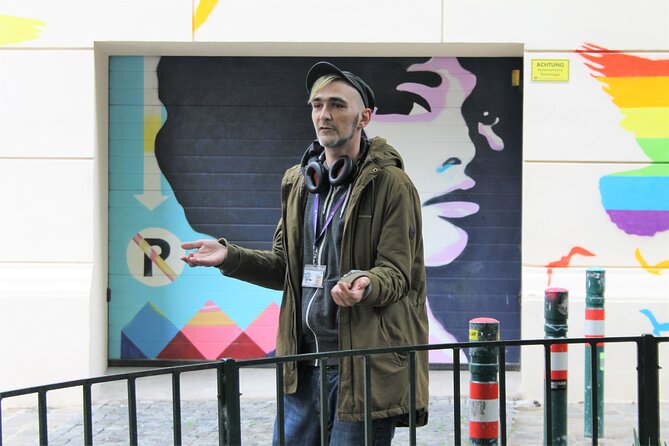
Martin leads from experience. He once slept rough in Vienna and speaks about the choices, dangers, and daily problems that shaped that period of his life. He also talks about his former drug addiction, which gives the discussion a personal weight that a standard social-history lecture cannot provide.
I appreciate that the experience is built around stories rather than a long list of dates. Martin’s approach is open and conversational. The information can be sad or shocking, but humor also appears, and that balance matters. The tone is not simply grim. It allows room for laughter without making light of serious problems.
You should expect an unusual kind of city walk. The main sights are not statues or grand interiors. The points of interest are ordinary public places that take on a different meaning once you hear how Martin used them and what happened around them.
Still deciding? These Vienna outings turn up in the same shortlists.
- Vienna: Vivaldi’s Four Seasons Concert in Karlskirche
★ 4.7 · 14,951 reviews - Vienna: Skip-the-cashier-desk-line Giant Ferris Wheel Ride
★ 4.5 · 7,859 reviews - Vienna: Schönbrunn Palace & Gardens Skip-the-Line Tour
★ 4.7 · 7,739 reviews
Starting beneath Karlsplatz
The meeting point is the Police Inspectorate Vienna at Kärntnertorpassage in the Karlsplatz area. The tour begins in the subway passage, then leaves through the exit next to the Secession.
That opening route gives you a quick change of perspective. Karlsplatz is one of Vienna’s best-known transport areas, yet the tour does not treat it simply as a convenient place to meet. The passage and nearby streets become part of the route into a less familiar side of the city.
On the way to the next station, you pass the Secession. This is useful for orientation, since you are moving from one of central Vienna’s familiar cultural landmarks toward places connected with Martin’s past. The walk is not presented as a conventional architecture tour, but passing the Secession helps you see how close these different versions of Vienna can be.
You should arrive ready to walk through city streets and use public spaces. The tour is approximately two hours, and the route includes places to sit at the first main stop and pause at the second.
Alfred-Grünwald-Park and the reality of sleeping outside
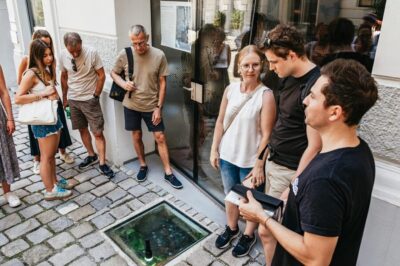
At Alfred-Grünwald-Park, the group can sit comfortably while Martin explains why the park became one of his sleeping places. This is one of the most important moments of the tour because it turns an abstract subject into a specific location.
A park may look restful during the day. Sleeping there is another matter. Martin explains why simply lying down on the grass is not always sensible, giving you a practical idea of the concerns that shape life without a secure room or bed.
The stop lasts about 20 minutes, which is long enough for a proper explanation without making the entire tour feel like a stationary talk. Sitting also helps here. Personal stories about homelessness need attention, and a quiet pause is better than trying to absorb them while hurrying along a pavement.
I find this kind of stop particularly useful for visitors who have only seen homelessness from a distance. It does not turn a person’s hardship into a spectacle. Instead, Martin explains what a particular place meant to him and how everyday decisions could involve safety, privacy, rest, and exposure.
The drawback is that you may find the material uncomfortable. That is part of the point, but you should not book this expecting a cheerful break in the park. The tour asks you to listen carefully and reconsider quick judgments.
The walk toward the final station
After Alfred-Grünwald-Park, the group continues through Vienna toward Ilse-Pisk-Stiege. The route remains connected to the city’s public spaces rather than leading to standard attractions.
The walk gives you time to process the first section. It also keeps the experience grounded in the city around you. Vienna is not being treated as a museum backdrop. Its streets, passageways, parks, and stairways are places where people live, meet, sleep, organize, and sometimes face police action.
The experience includes enough movement to feel like a walking tour, but the advertised duration is only about two hours. That is a good fit if you want something substantial without giving up half a day. At the same time, do not expect to cover a large number of conventional sights. The value lies in the guide’s explanations, not in the number of stops.
A different sort of day out in Vienna:
- Vienna: Light of Creation Votive Church Immersive Light Show
★ 4.8 · 6,779 reviews - Vienna Spanish Riding School Guided Tour
★ 4.7 · 6,765 reviews - Vienna: Classical Concert in the World-Famous Musikverein
★ 4.6 · 6,673 reviews - Vienna: Skip-the-Line Sisi Museum, Hofburg and Gardens Tour
★ 4.8 · 5,918 reviews
Ilse-Pisk-Stiege and Vienna’s squat history
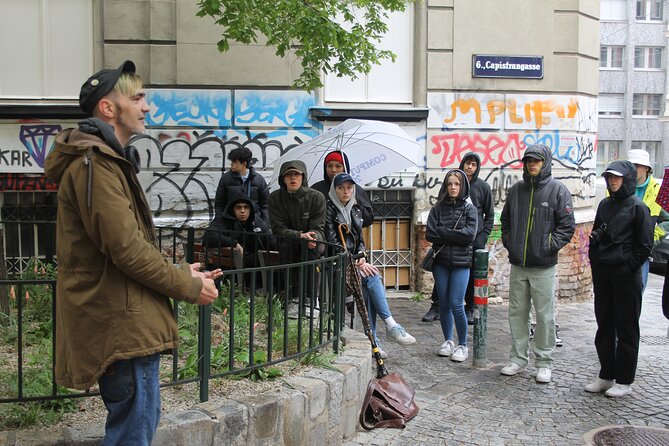
The last main stop is Ilse-Pisk-Stiege, also known as the Capistran Ascent. The stairs offer a place for a final breather while Martin talks about squats and punk communities.
This section adds a wider social and political angle to the personal story. You hear about the networks and communities connected with squatting, as well as the conflicts that can arise when occupied buildings face eviction.
The most striking example is the evacuation of the pizzeria Anarchia. Martin explains how a building occupied by 19 people was cleared by 1,700 police officers. The scale of that operation makes the story memorable, and it gives you a concrete way to think about the tensions surrounding occupied buildings, authorities, and alternative communities.
The topic is not just local color. It helps explain a part of Vienna that most visitors would never encounter on a palace tour. The punk and squat history also brings some humor into the experience, according to the tone of Martin’s storytelling. That lighter touch helps keep the discussion from becoming a string of grim facts.
The stairs may be less comfortable than a park seat, and anyone who dislikes stopping on steps should keep that in mind. Still, the location fits the subject. You are hearing about public life, protest, and unconventional communities in a setting that feels connected to the city’s everyday streets.
Finishing near Esterhazypark and Haus des Meeres
The tour ends at Esterhazypark, next to Haus des Meeres in the Mariahilf area. This is a practical finish because you are not returned to the starting point. Plan your next activity from the endpoint rather than assuming you will finish at Karlsplatz.
The location gives you an easy reference point for continuing your day, though no further sightseeing is included in the tour itself. You might choose to visit Haus des Meeres separately, explore the surrounding neighborhood, or use public transportation from the area.
This start and finish arrangement also means you see more of Vienna as you move across the city. It is not a loop, and that helps the walk feel like a short journey rather than a talk in one fixed location.
Why the personal guide matters
Martin is the center of the experience. His background as a former homeless person and former drug addict is not a small detail in the tour description. It shapes the entire way the topics are presented.
You hear about homelessness from someone who has dealt with its practical realities. You also hear about addiction without the distance of a textbook account. That does not mean every answer will match your expectations, and you should allow room for a personal perspective rather than treating the tour as a complete study of Vienna’s social services or housing policy.
What Martin offers is a human account. He explains what happened to him, what everyday life was like, and how he viewed the places connected with that period. His willingness to answer questions is a strong part of the format. Several comments about the experience point to the value of asking direct questions and receiving additional explanations along the way.
His humor is also important. The subject can become heavy, but Martin uses jokes and a warm manner to keep the group engaged. That does not remove the seriousness of addiction or homelessness. It makes two hours of difficult material easier to follow.
How much the $46 price is worth
At $46, this is priced above a basic free walking tour, but it offers something a standard city walk cannot easily provide: a guide’s direct personal account, a focused route, and access to stories tied to specific locations.
You are paying mainly for interpretation, not admissions. The stops are public places, and there are no major entrance tickets included. That makes the value depend on how much you want this subject and how much you value a personal, conversational guide.
I think the price makes sense if you want to understand Vienna beyond its famous buildings and are prepared to listen to difficult material. It may feel expensive if you want a conventional sightseeing tour with many attractions, photographs, or interior visits.
Group discounts are available, which may improve the value for schools, youth groups, or organizations. The maximum group size is 20, a useful limit for a tour built around personal discussion. A smaller group generally makes it easier to hear the guide and ask questions, though the actual number in your session can vary.
Who should book this experience
This tour suits adults and teenagers who want a more honest look at urban life. It has also worked well for school classes, particularly because it is short, discussion-based, and easy to connect with lessons about addiction, poverty, tolerance, social exclusion, and civic responsibility.
You may also like it if you have already seen Vienna’s main sights and want a fresh subject. The tour does not require specialist background knowledge. Martin explains his experiences in a direct way, and English is available, according to the information provided.
It is less suitable if you want a relaxed sightseeing walk, a polished historical presentation, or a family outing built around cheerful attractions. The subject includes drug use, homelessness, and forced eviction. Younger teenagers may need a parent or teacher to decide if the material is appropriate.
Dogs are allowed, and service animals are allowed. The activity is near public transportation, and most people can participate. Since the route includes walking, a park stop, and stairs at Ilse-Pisk-Stiege, you should consider your own comfort with those conditions before booking.
Booking, timing, and cancellation details
You receive confirmation when you book, and a mobile ticket is available. The tour lasts about two hours and accepts a maximum of 20 people.
Free cancellation is available if you cancel at least 24 hours before the scheduled start time. Cancellations within 24 hours are not refunded, and changes inside that window are not accepted. The tour also requires a minimum number of participants. If that minimum is not reached and the experience is canceled, you are offered another date or experience, or a full refund.
The start point is at Kärntnertorpassage near Karlsplatz. The end point is Esterhazypark, next to Haus des Meeres. Check both locations before setting out, since this is a point-to-point walk.
Should you book the Alternative Tour in Vienna?
Book it if you want a personal and challenging view of Vienna, not another procession past grand buildings. Martin’s story, the park where he once slept, the discussion of addiction, and the account of the Anarchia evacuation give the tour a clear purpose.
I would especially recommend it for adults, older teenagers, school groups, and repeat visitors who want to question their first impressions of homelessness and poverty. The two-hour format keeps it focused, while the small maximum group gives the subject room for questions.
Skip it if you want a light, conventional city tour or know that stories about addiction and rough sleeping will be too upsetting. For the right audience, though, the $46 cost buys something rare in sightseeing: a chance to see familiar Vienna through a life experience most visitors could never access on their own.
FAQ
How long is the Alternative Tour in Vienna?
The tour lasts approximately two hours.
Where does the tour begin?
It begins at the Police Inspectorate Vienna in Kärntnertorpassage near Karlsplatz, at Kärntnertorpassage, 1010 Vienna.
Where does the tour end?
The tour ends at Esterhazypark, next to Haus des Meeres.
Who leads the tour?
The guide is Martin, who previously lived on the streets of Vienna and speaks about homelessness, addiction, and squatting from personal experience.
What subjects does the tour cover?
It covers homelessness, drug addiction, sleeping rough, squats, punk communities, and the evacuation of the pizzeria Anarchia.
What are the main stops?
The main stops are Alfred-Grünwald-Park and Ilse-Pisk-Stiege, also called the Capistran Ascent.
How many people can join?
The tour has a maximum capacity of 20 people.
Are dogs and service animals allowed?
Yes. Dogs are allowed, and service animals are allowed.
Can I cancel for a full refund?
Yes, if you cancel at least 24 hours before the experience begins. Cancellations within 24 hours are not refunded.
Just reviewed in Vienna
- World War II History Vienna Old Town Private Walking Tour★ 4.8 · 9 reviews
- Vienna: Wine Tasting E-Bike Tour★ 4.9 · 46 reviews
- Vienna: Winery and Wine Tasting Tour with a Wine Expert★ 5.0 · 5 reviews
- Vienna: Unforgettable Private City Tour★ 5.0 · 7 reviews
- Vienna Urban Art Tour: Explore a different side of Vienna!★ 3.8 · 14 reviews
- Vienna: Concert by the Vienna Baroque Orchestra★ 4.6 · 56 reviews
- Vienna: Sunday Brunch Danube Cruise & Live Music★ 4.2 · 42 reviews
- Vienna Supreme Orchestra at Palais Niederösterreich★ 4.8 · 10 reviews
Tours, compared.

Skip-the-Line Sisi Museum, Hofburg and Gardens Tour
Read our review →
Guided Walking Tour of City Highlights & Hidden Gems
Read our review →