
Reviewed · WALKING TOURS
Private Introduction to Vienna Walking Tour
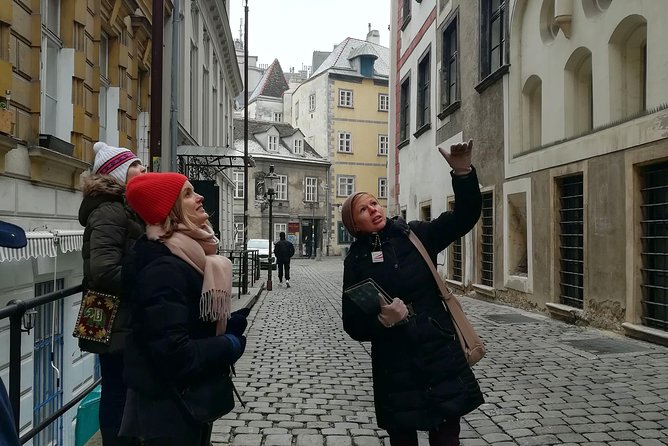
Vienna’s story comes into focus when you connect its grand buildings, royal burial customs, Ottoman sieges, and modern cultural life in one walk. I like the private format, which lets your guide adjust the pace and answer your family’s questions. I also like the unusual Habsburg burial story: hearts, entrails, and bodies rest in different churches.
The main thing to consider is the price: $566.25 for up to 10 people is a serious outlay for three hours. You also cover a lot of ground on foot, so this works best when your group wants a broad city orientation rather than long interior visits.
Key points to know before booking
- Habsburg history with a personal guide: The walk links the Hofburg, Capuchin Church, St. Augustine’s Church, and St. Stephen’s Cathedral.
- A strong first-day orientation: You see the imperial center, Ringstrasse area, Belvedere, Naschmarkt, and MuseumsQuartier in one morning or afternoon.
- Private group of up to 10: Your guide can tailor the pace and discussion to your party rather than follow a large group.
- Several named guides receive praise: Katarina, Selin, Biljana, and Else are described as warm, clear, energetic, and good with families.
- A walking tour, not a museum tour: The emphasis is on streets, squares, architecture, and explanation from outside, with food and drinks not included.
- Plan ahead: The tour is often reserved about 70 days in advance, and pickup must be arranged if you do not want to meet at Cafe Hawelka.
Why this walk works as a Vienna introduction
Vienna can feel grand but oddly spread out. The imperial palace, cathedral, Ringstrasse, palace gardens, museums, and markets each tell part of the story. This tour gives you a useful map in your head while explaining why the city looks the way it does.
The three-hour length is long enough to cover major landmarks but short enough to fit into a first full day. You are not committing to an entire day with a guide, and the private setting gives you room to ask about subjects that interest your group.
I especially like the way the route mixes famous sights with less obvious details. You get the Hofburg and St. Stephen’s Cathedral, of course, but also Adolf Loos’s Loos House, the old city walls, the Russian memorial at Schwarzenbergplatz, and the Habsburgs’ unusual burial tradition.
The tour is offered in English with a historian guide. Several guides have led it, including Katarina, Selin, Biljana, and Else. The feedback about these guides is consistently strong, with particular praise for storytelling, warmth, pacing, and the ability to shape the walk around a family or couple.
More walking tours in Vienna:
- Vienna: Guided Walking Tour of City Center Highlights
★ 4.7 · 4,989 reviews - Vienna: Vienna Central Cemetery Guided Walking Tour
★ 4.8 · 3,307 reviews - Vienna: Guided Walking Tour of City Highlights & Hidden Gems
★ 4.9 · 2,180 reviews
Starting at Michaelerplatz and the Hofburg
The meeting point is Cafe Hawelka at Dorotheergasse 6, in central Vienna. Unless hotel pickup has been arranged, you should meet your guide 15 minutes before the start time.
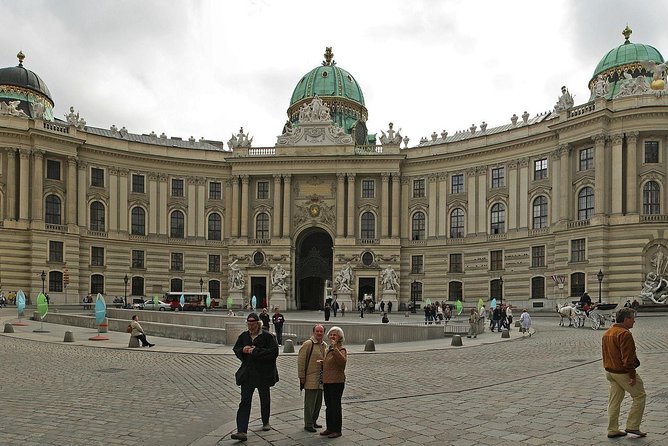
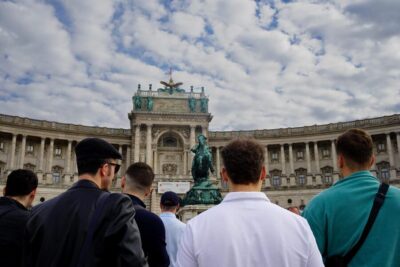
From there, the walk begins at Michaelerplatz, one of the best places to understand Vienna’s imperial center. The Hofburg dominates the square. It served as the Habsburg seat of power from the thirteenth century, and its scale tells you immediately that Vienna was built to project authority.
Your guide can help you read the layers around the square. Imperial buildings sit beside modern architecture, and the green and gray Loos House provides a sharp contrast to the palace. Adolf Loos designed it in the early twentieth century, and its plain exterior caused a stir beside the ornate Hofburg.
This is a good opening because it shows that Vienna is not frozen in the age of emperors. The city kept changing, and its architecture records those changes. You get royal ceremony, modern design, and public debate in one square.
The guide’s explanation matters here. Without context, Michaelerplatz can look like another impressive European square. With a clear account of the Habsburgs and the buildings around you, it becomes a quick lesson in how power shaped the city.
Kohlmarkt, the Graben, and St. Stephen’s Cathedral
The route continues along Kohlmarkt and the Graben, two of Vienna’s best-known central streets. Today they are fashionable shopping areas, but their importance goes beyond stores and cafes.
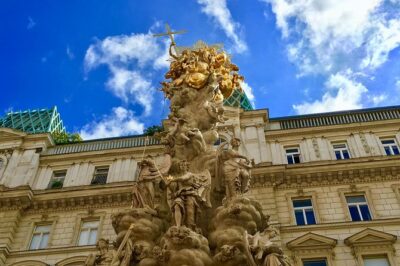
The Graben is lined with grand buildings in several styles. Look for the plague column, erected after a devastating outbreak, and the baroque church of St. Peter. Your guide can help separate the decorative details from the events behind them, including the religious and political messages built into the streets.
The route then reaches Stephansdom, Vienna’s national architectural symbol. Its roof and tower make it easy to spot, but the cathedral is more than a photo stop. It is one of the places tied to the Habsburg burial tradition, holding the imperial entrails.
That detail may sound strange to modern ears, but it reveals how the dynasty treated the body of a ruler as a set of important relics. The heart, entrails, and body were placed in different locations, giving Vienna three separate sites connected to imperial death.
You should not expect an extended cathedral visit or a dedicated interior tour based on the listed plan. The value here is the citywide connection: the cathedral becomes one part of a larger story that continues at the Capuchin Church and St. Augustine’s Church.
The Habsburgs’ three-part burial tradition
The burial stops are among the most distinctive parts of the walk. The Capuchin Church contains centuries of sarcophagi for Vienna’s rulers. Its setting is more modest than the Hofburg, which makes the contrast useful. Imperial power could be grand in life and solemnly contained in death.
St. Augustine’s Church holds silver urns containing the hearts of Habsburg family members. St. Stephen’s Cathedral is associated with the entrails. Together, these three places create an unusual route through Vienna’s royal past.
I like this section because it moves beyond the usual list of palaces and composers. It gives you a human, slightly unsettling detail about dynasty and ceremony. It also shows how closely religion and government were tied in Habsburg Vienna.
Keep in mind that the tour is primarily a walking history experience. Food and drinks are not included, and the schedule is built around seeing several areas rather than sitting down for long visits at each church. If your group wants to study interiors in detail, you may need to return on your own.
A few more Vienna outings worth weighing up
- Vienna: Private Walking Tour with a Local Guide
★ 4.6 · 1,420 reviews - Vienna: Private Walking Tour with a Guide
★ 4.7 · 962 reviews - Vienna: Wine Tasting Experience in a Private Wine Cellar
★ 4.8 · 413 reviews - Private Day Tour Trip Salzburg Hallstatt and Melk from Vienna
★ 5.0 · 388 reviews
Old city walls and the Ringstrasse idea
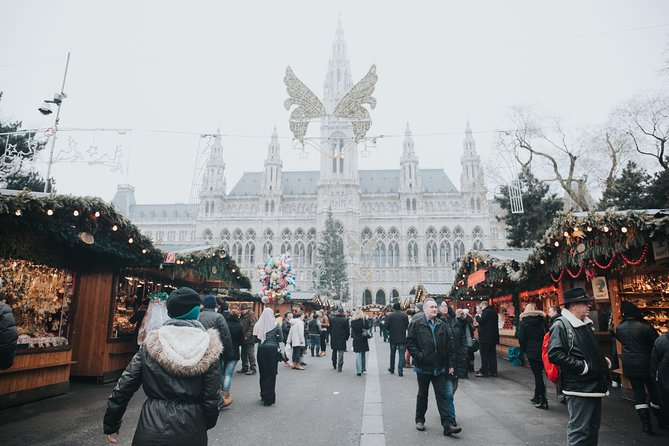
Along the edge of the inner city, the walk points out remains of Vienna’s twelfth-century walls. These defenses helped protect the city during Ottoman sieges in 1529 and 1683.
The walls were eventually removed, and their former footprint helped make room for the Ringstrasse. Vienna’s grand circular boulevard became the city’s answer to the monumental boulevards of Paris. This change tells you a great deal about nineteenth-century Vienna: old defenses gave way to ceremonial roads, public buildings, and a capital designed for display.
This part of the tour is valuable because it helps you understand scale. The Ringstrasse is not simply a pretty road. It represents a shift from medieval defense to imperial confidence and urban planning.
You may find that this section feels less dramatic than the Hofburg or cathedral. The remains of walls are not always visually grand, but the historical link is strong. A good guide can make the change from medieval fortification to modern boulevard easy to picture.
Schwarzenbergplatz and the Russian memorial
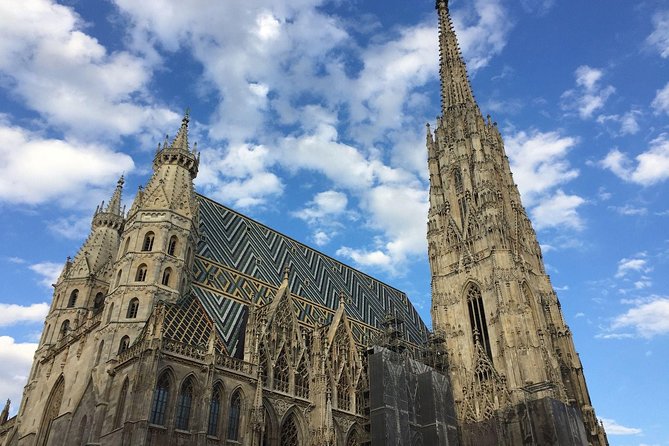
The walk continues to Schwarzenbergplatz, an open area marked by a large fountain and a memorial to Russian soldiers who died liberating Vienna from the Nazis.
This is one of the route’s more politically charged stops. It brings the story out of the Habsburg era and into the twentieth century. Vienna’s past is not only palace rooms and baroque churches. It also includes war, occupation, liberation, and the difficult memory attached to monuments.
The area is also associated with many embassies. That gives your guide a natural opening to discuss Vienna as a modern capital, not simply a former imperial center.
I appreciate this change of tone. A tour focused only on royal Vienna can leave you with a polished but incomplete picture. Schwarzenbergplatz adds a reminder that the city has had to deal with much darker chapters.
The Belvedere detour and the view toward Karlsplatz

The itinerary includes a quick detour to Belvedere Palace before heading back toward Karlsplatz. The palace is one of Vienna’s best-known landmarks, and even a short look adds another piece to the city’s architectural story.
Because the detour is described as quick, do not plan on a full palace or gallery visit during these three hours. If Belvedere is high on your list, reserve separate time for it. Here, the point is to connect the palace with the wider route and give you a sense of how Vienna’s grand buildings sit in relation to one another.
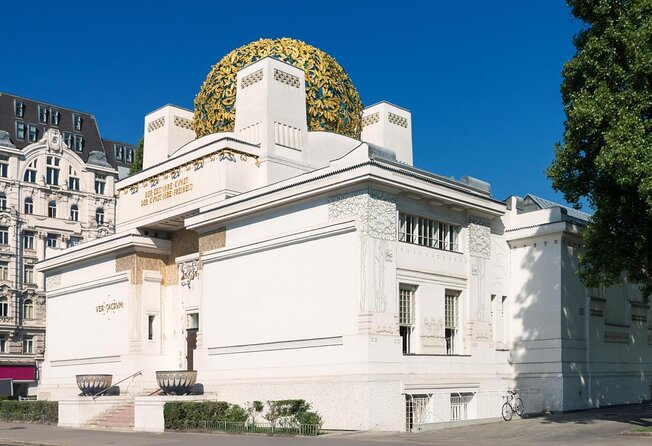
The walk then reaches Karlsplatz, where you can enjoy a view toward the gold-domed Secession building and the Naschmarkt. The Secession is a major Austrian architectural symbol, with a style very different from the baroque and imperial buildings seen earlier.
Naschmarkt adds a more everyday side of Vienna. It is a useful counterpoint to palaces and official monuments, though the tour does not include food or drinks. If you want to browse or eat there, ask your guide how much time remains or return later.
MuseumsQuartier and Maria Theresien Platz
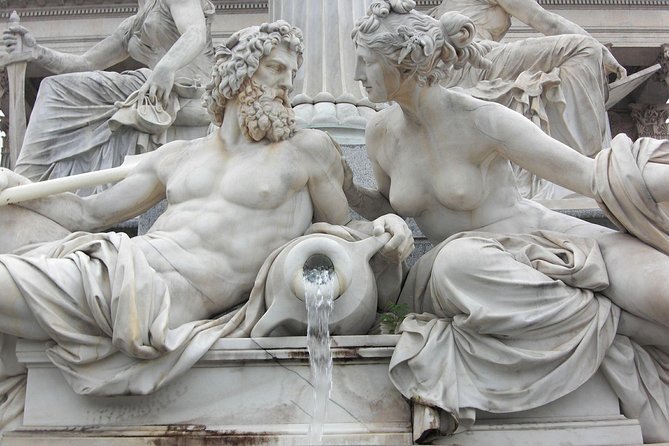
The final part of the route moves through MuseumsQuartier and Maria Theresien Platz. This is a strong ending because it brings the city into the present.
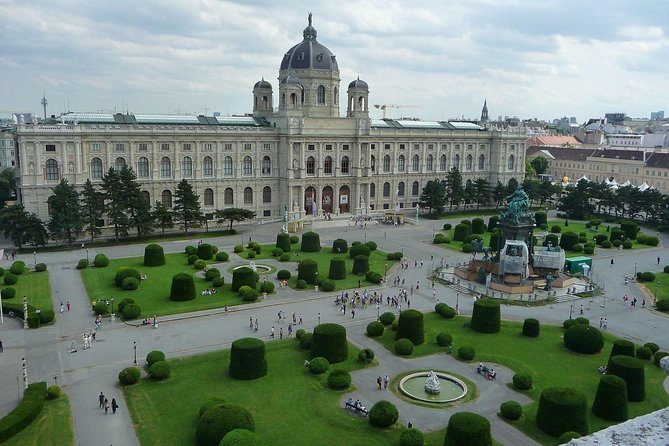
Maria Theresien Platz holds Vienna’s largest concentration of museums, while MuseumsQuartier represents the city’s modern cultural life. After hearing about emperors, churches, military defenses, and royal burial customs, you finish by discussing Austria’s current cultural, political, and economic direction.
That last conversation is one of the tour’s most useful features. A city introduction should not stop in 1918, and this route does not. You get a chance to ask how Vienna functions today and how its imperial past still shapes its public image.
The route also ends with a broader sense of Vienna’s neighborhoods. You have crossed central shopping streets, ceremonial squares, palace districts, museum areas, and a market zone. You will not know every corner of the city, but you will have a strong starting framework for exploring on your own.
Pace, group size, and what the private format changes
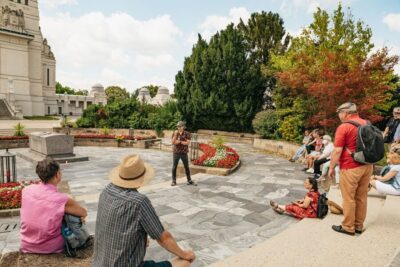
This is a private activity for your group alone, with up to 10 people. That matters most if your party includes children, young adults, or family members with different interests.
The pace can be more personal than on a large scheduled walk. One family found the experience well suited to children and young adults in their twenties, while another couple appreciated seeing a great deal without feeling rushed. Those details suggest that the guides are comfortable adjusting the rhythm, though the total route still covers a lot of ground.
Else is specifically praised for meeting a couple at their hotel, moving efficiently between sights, and combining historical, religious, and cultural stops. Biljana is praised for storytelling and a pace that worked for a family. Selin is described as tailoring the walk closely to one family, and Katarina is associated with a strong first morning in Vienna.
The tour is not designed for people who want a slow coffee break at every stop. Three hours and this many districts require steady movement. Wear comfortable shoes and treat the experience as an orientation walk, not a series of long museum visits.
Is $566.25 good value for your group?
The listed price is $566.25 per group of up to 10 people, not per person. For a full group, the per-person cost becomes much more reasonable. For two people, it is a substantial price for a three-hour activity.
The value comes from the private guide and the amount of ground covered. You are paying for a personal historian-led route through Vienna’s central landmarks, not simply for entry to one attraction. If your group has six to 10 people, the price is easier to justify because everyone shares the same fee.
For a couple on a tight budget, a less expensive group walk may make more sense. For a family that wants one clear introduction and prefers to ask its own questions, the private setup has real advantages.
The tour is also often booked around 70 days ahead. That does not guarantee every date will fill, but it is a useful signal to plan early, especially if you need a particular morning or want hotel pickup.
Who should book this Vienna walking tour?
Book it if you want a clear first look at Vienna and prefer a guide who can connect buildings to politics, religion, architecture, and modern life. It is particularly well suited to families, first-time visitors, and groups that value a private pace.
It is also a good choice if you want to see many important areas before deciding where to spend more time. You can use the walk to choose a later visit to the Hofburg, Belvedere, Stephansdom, museums, or Naschmarkt.
Think twice if you dislike long walks, want extensive time inside each monument, or are traveling as only two people and find the price hard to absorb. The route is broad rather than slow, and food, drinks, and attraction admission are not included.
For the right group, I would book it near the start of a Vienna stay. The mix of imperial landmarks, odd royal customs, war memory, modern design, and museum culture gives you a useful way to read the city for the rest of your visit.
FAQ
How long is the Vienna walking tour?
The tour lasts approximately three hours.
How much does the private tour cost?
The price is $566.25 per group of up to 10 people.
Is the tour private?
Yes. Only your group participates in the activity.
What language is the tour offered in?
The tour is offered in English.
Where does the tour begin?
Unless hotel pickup has been arranged, meet your guide at Cafe Hawelka, Dorotheergasse 6, 1010 Vienna.
When should I arrive at the meeting point?
You should meet your guide 15 minutes before the scheduled start time.
Is hotel pickup available?
Pickup is offered, but it must be arranged. Otherwise, you meet at the default meeting point.
Are food and drinks included?
No. Food and drinks are not included unless specifically stated.
Can I cancel for a full refund?
Yes. You can cancel at least 24 hours before the experience start time for a full refund. Cancellations or changes made less than 24 hours before the start time are not accepted for a refund.
Just reviewed in Vienna
- World War II History Vienna Old Town Private Walking Tour★ 4.8 · 9 reviews
- Vienna: Wine Tasting E-Bike Tour★ 4.9 · 46 reviews
- Vienna: Winery and Wine Tasting Tour with a Wine Expert★ 5.0 · 5 reviews
- Vienna: Unforgettable Private City Tour★ 5.0 · 7 reviews
- Vienna Urban Art Tour: Explore a different side of Vienna!★ 3.8 · 14 reviews
- Vienna: Concert by the Vienna Baroque Orchestra★ 4.6 · 56 reviews
- Vienna: Sunday Brunch Danube Cruise & Live Music★ 4.2 · 42 reviews
- Vienna Supreme Orchestra at Palais Niederösterreich★ 4.8 · 10 reviews
Walking Tours, compared.
Guided Walking Tour of City Highlights & Hidden Gems
Read our review →
Vienna Historic Center Small Group Walking Tour
Read our review →
Browse the lists this tour appears in