
Reviewed · WALKING TOURS
Vienna: Hidden Secrets and Local Stories Walking Tour
Vienna’s grand center is easy to admire, but its best stories often hide behind plain doorways and narrow lanes. This two-hour walk leads you from St. Stephen’s Cathedral through courtyards, old university streets, Ballgasse, Blutgasse, and the Franciscan quarter, mixing solid facts with amusing local tales.
I like the small-group format, which makes it easier to ask questions and chat with guides such as Herbert or Wolfgang. I also like the way the tour corrects familiar myths, including the popular version of Mozart’s life, instead of simply repeating the usual Vienna story. The main drawback is practical: the route is on foot, runs in all weather, and is not suitable for wheelchair users, people with mobility impairments, or children under 12.
Key points at a glance
- Mozart beyond the tourist story: Visit the composer’s final residence and hear a more accurate account of his life.
- Courtyards and side streets: Walk through Ballgasse, Blutgasse, Domgasse, and other corners many visitors pass without noticing.
- Major sights included: See St. Stephen’s Cathedral, the Franciscan Church and Monastery, the Jesuit Church, and the old city wall.
- Funny, fact-filled guiding: Herbert and Wolfgang are known for an engaging style, quizzes, anecdotes, and clear explanations.
- Good value for a central walk: At $33 for two hours, the tour costs about $16.50 per hour, including a certified local guide.
- Small-group limitations: Bring comfortable shoes and travel light. Large bags, luggage, audio recording, and mobility aids are not suitable for this walk.
What this Vienna walk is really about
This is not a grand sightseeing circuit designed to check off every major palace in the city. It focuses on the old center, where Vienna’s biggest landmarks sit close to small lanes, church courtyards, old homes, and buildings with odd names.
That contrast is the point. You may begin with the imposing bulk of St. Stephen’s Cathedral, then turn into a much quieter street and hear a story about a courtyard, a local custom, or a piece of Viennese folklore. The guide explains which tales are true, which are fictional, and which have been polished by generations of retelling.
I find that approach useful in Vienna. The city presents itself with great confidence, and some popular stories are repeated so often that they sound certain. A guide who pauses to correct false information gives you a better sense of how the city actually works.
The pace is a steady walk rather than a strenuous hike. Still, the route includes narrow streets and historic areas with uneven surfaces. The tour takes place in all weather, so a rain jacket and comfortable shoes are sensible choices. Large bags and luggage are not allowed, and audio recording is not permitted.
More walking tours in Vienna:
- Vienna: Guided Walking Tour of City Center Highlights
★ 4.7 · 4,989 reviews - Vienna: Vienna Central Cemetery Guided Walking Tour
★ 4.8 · 3,307 reviews - Vienna: Guided Walking Tour of City Highlights & Hidden Gems
★ 4.9 · 2,180 reviews
Starting near St. Stephen’s Cathedral
The meeting point is listed at a Bankomat, with the exact starting point depending on the option you book. Check your booking details carefully before setting out, since the meeting instructions may vary.
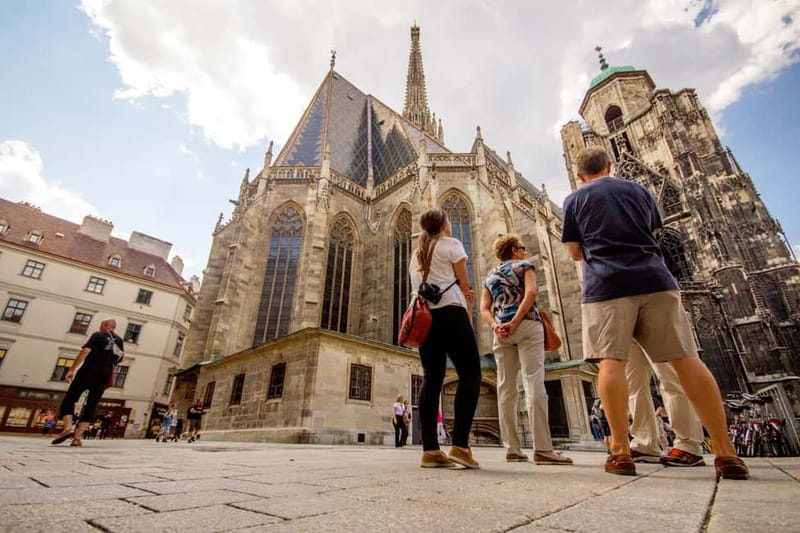
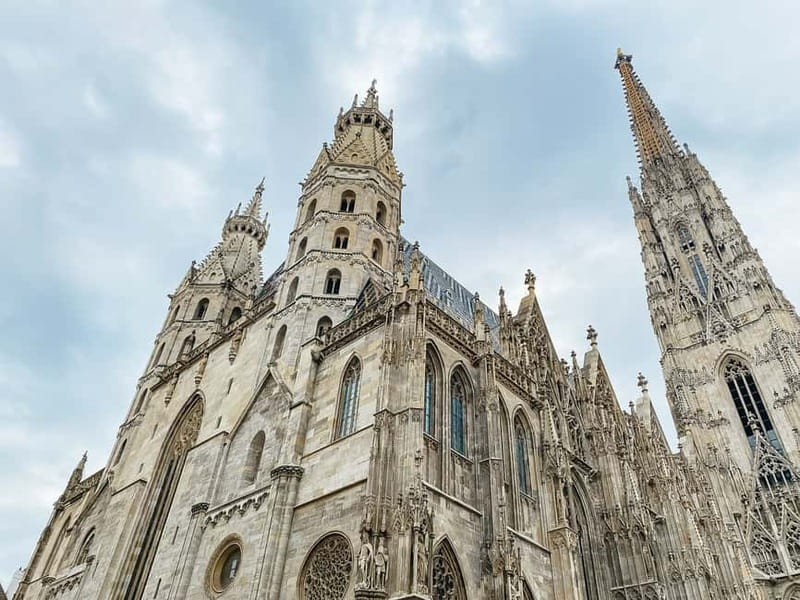
From there, the walk reaches Stephansplatz and St. Stephen’s Cathedral. This is Vienna’s most obvious landmark, but the guide uses it as more than a photo stop. You get context about the cathedral, the surrounding square, and the way this central area connects to the smaller streets around it.
The cathedral is also a useful orientation point. If this is your first walk through Vienna, the opening section helps you understand the shape of the old center. You will be able to place Domgasse, Ballgasse, Blutgasse, and the old university area in relation to the main square.
Do not expect an extended interior visit or a formal architectural lecture. The supplied details describe a guided stop, not a separate cathedral admission or a full indoor tour. The value here is the setting and the explanation, especially if you want to understand what you are seeing before exploring on your own.
Mozart’s final residence and the facts behind the legend
Mozart’s final residence is one of the most useful stops for visitors who know the usual story but want something more accurate. The address is connected with Domgasse, close to the cathedral, and the guide uses it to discuss the composer’s life in Vienna.
This part should appeal to anyone tired of the same simplified Mozart narrative. The tour promises to explain the truth of his life, which means you can expect some correction of familiar claims rather than a string of romantic legends.
The stop is also a good example of the tour’s overall method. A famous person gives you an easy entry point, but the guide moves beyond the name on the building. You learn how a real place fits into the city’s streets and daily life.
The tour does not list a museum entry as part of the experience. Treat this as an exterior historical stop and guided explanation unless your booking information says otherwise. If you want to visit the residence museum, plan that separately.
Ballgasse, Blutgasse, and Vienna’s quieter lanes
Ballgasse and Blutgasse are where the tour begins to feel different from a standard central Vienna walk. These lanes are close to major sights, yet they can be easy to overlook if you follow only the broad routes between Stephansplatz and the Hofburg.
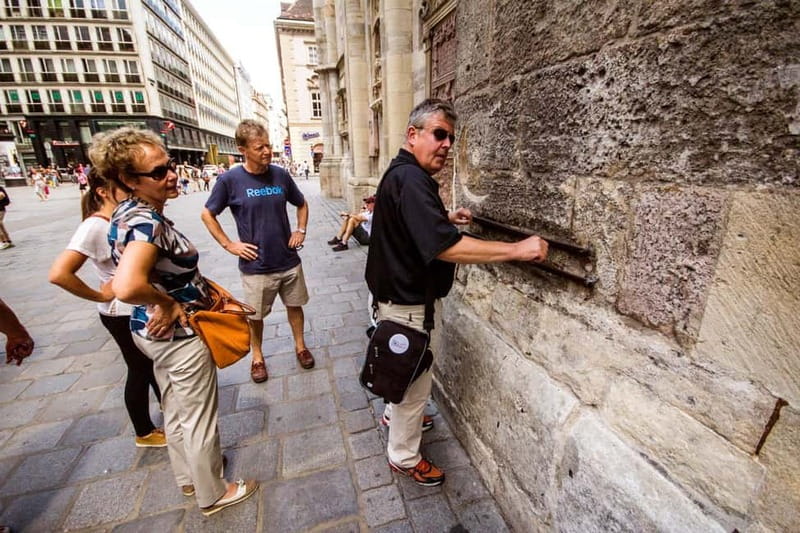
The guide points out details in the buildings and explains the stories attached to them. Some are amusing. Some are factual. Some have grown into local legends. That mix keeps the walk lively, while the small group gives you a better chance to hear the guide in tight spaces.
Blutgasse is especially suited to this kind of storytelling. The name itself invites questions, and Vienna has no shortage of explanations for unusual street names. The important benefit is not simply remembering one tale. You begin to notice how much information is packed into the names and layouts of old streets.
You also pass the house known as Where the cow plays on the board. It is an unusual detail, exactly the sort of thing you might miss without a guide. This stop helps show why a local walk can add value even in an area you could technically explore by yourself.
A different sort of day out in Vienna:
- Vienna: Vivaldi’s Four Seasons Concert in Karlskirche
★ 4.7 · 14,951 reviews - Vienna: Skip-the-cashier-desk-line Giant Ferris Wheel Ride
★ 4.5 · 7,859 reviews - Vienna: Schönbrunn Palace & Gardens Skip-the-Line Tour
★ 4.7 · 7,739 reviews - Vienna: Light of Creation Votive Church Immersive Light Show
★ 4.8 · 6,779 reviews
Franciscan Church, monastery, and Palais Neupauer-Breuner
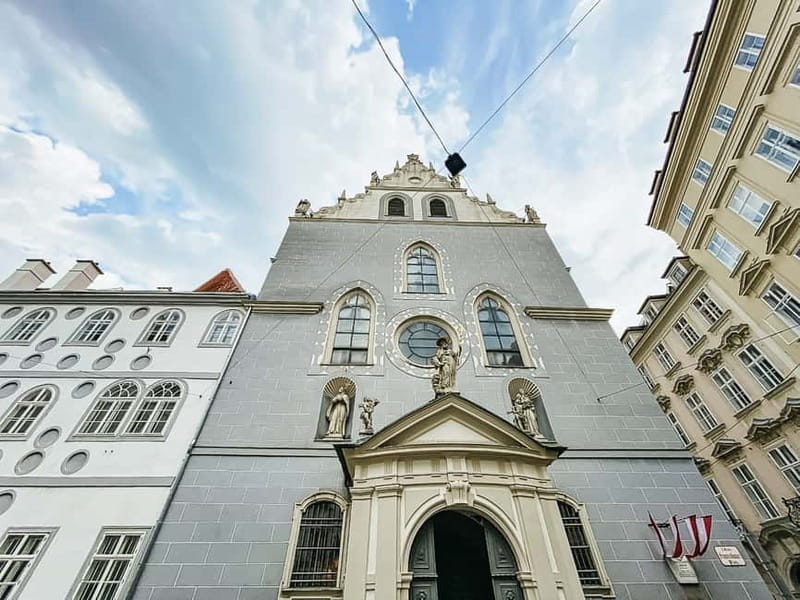
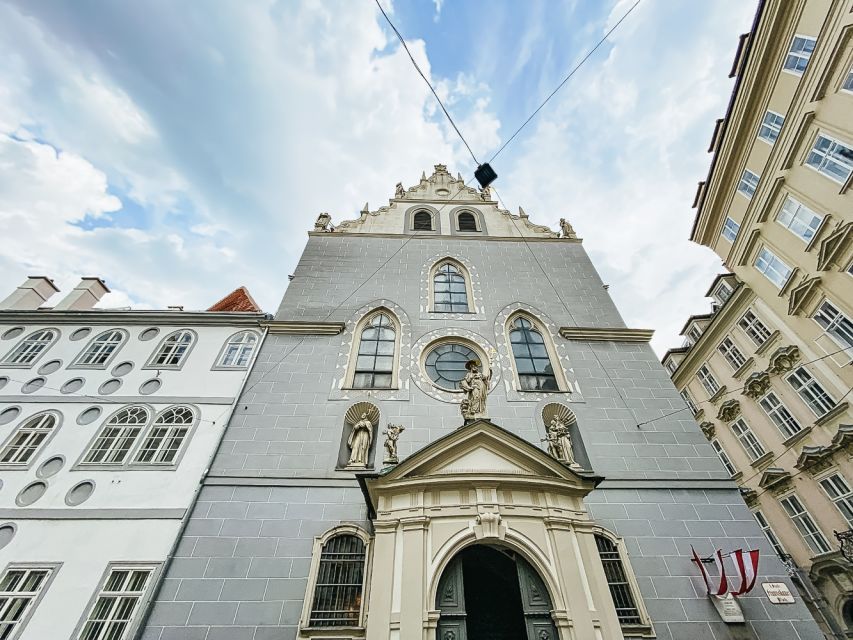
The Franciscan Church and Monastery offer a change of mood from the busy cathedral area. The church is included as a guided stop, and the surrounding setting gives the guide another chance to explain Vienna’s religious and architectural layers.
You also see Palais Neupauer-Breuner. A palace name may sound grand, but the point of including it is to show how aristocratic buildings fit into the ordinary street plan of the old center. Here, a short walk can reveal a church, a palace, a private residence, and a narrow lane within a very small area.
The Deutsches Haus is another stop along the route. The tour does not promise entry into every building, so you should think of these locations as viewed and explained from the street. That is normal for a two-hour walk and keeps the focus on the city itself rather than on a series of admission queues.
The Franciscan section is particularly useful if you want more than the standard imperial Vienna story. It brings in religious buildings, local neighborhoods, and smaller civic details that can be lost between the grand palace stops.
The old university district and Jesuit Church
The route continues toward the old university district and the Jesuit Church. This part broadens the story of Vienna beyond music, palaces, and imperial life.
The university area gives you a look at another side of the old city. The guide connects the streets and buildings to Vienna’s academic past, while the Jesuit Church adds an important religious landmark to the walk.
You also hear about the old city wall. Vienna’s modern center gives little sense of a fortified medieval town unless someone points out what to look for. This explanation helps you read the city as a place that changed over time, rather than as a collection of isolated monuments.
The route is not designed to provide long stops at every location. Instead, you move through several connected areas and build a larger picture of central Vienna. I think this works well for a first or second day in town, when you want orientation along with stories.
Food, courtyards, and everyday Vienna
Traditional Viennese cuisine is part of the discussion, though this is not a food tour and no meal or tasting is included. The food references help connect the historic streets to local life. You hear about what Vienna eats while walking through the places where residents have lived, worked, worshiped, and studied.
That is a useful balance. The tour does not treat Vienna as a museum set. It gives you practical local recommendations as well, with insider suggestions from a Viennese guide. The exact recommendations can vary by guide, but this is a good moment to ask where to eat or what to try later.
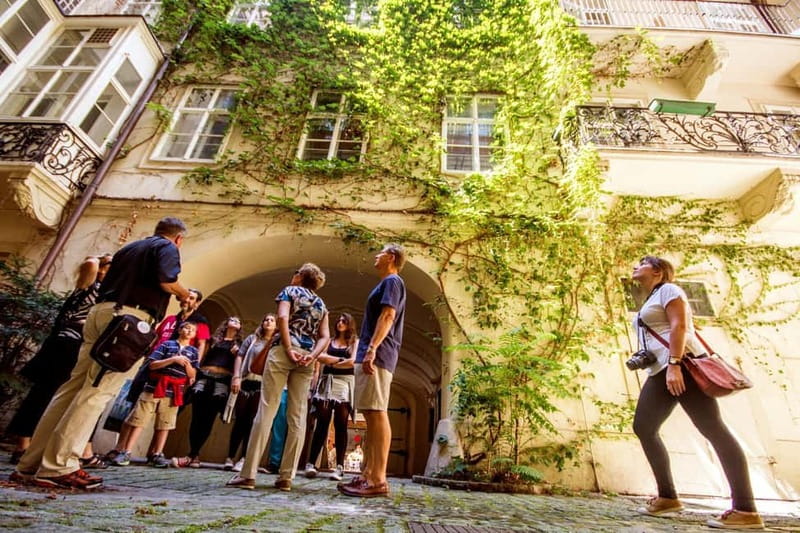
The courtyards are another strong part of the experience. Vienna’s outer façades can look formal and uniform, while the spaces behind them often reveal a more private side of the city. Access to every courtyard is not guaranteed, but the route is built around these less obvious parts of the center and the legends connected with them.
If you like small details, unusual names, and the explanation behind a doorway or alley, you will get more from this walk than someone who wants only landmark photographs.
Guide style and group size
The tour is led in German or English by a certified tourist guide and native speaker. Herbert Stojaspal is the experience provider, and guides named Herbert and Wolfgang have led the walk. The guiding style is clearly a major part of the appeal.
Herbert is described as funny, engaging, and willing to quiz the group as he goes. That can make a difference on a walking tour. Instead of listening to a long speech at each stop, you may be asked to think about a detail, guess at a story, or compare the popular version with the evidence.
Wolfgang is also described as entertaining and easy to follow. One especially useful feature of the small-group setting is the chance to speak with the guide rather than simply stand at the back of a crowd.
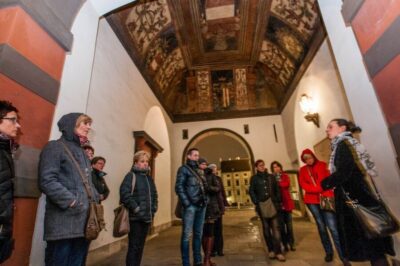
The group size is limited, though the exact maximum is not given. One group had 10 people, which gives you a reasonable idea of the intimate format, but you should not assume every departure will have the same number. A small group can make narrow streets easier and questions more practical.
The tour can still work in rain. A good host has kept the experience moving during wet weather, but you should dress for the conditions instead of expecting to wait indoors.
Is $33 a fair price?
At $33 per person for two hours, this is not the cheapest way to walk around central Vienna. You can see many of these streets for free with a map. The question is what you are paying to understand.
The price includes a certified guide, a native speaker, local recommendations, and a planned route through places you might otherwise pass without noticing. At roughly $16.50 per hour, the cost is reasonable if you value interpretation and a small group.
There is no listed meal, museum admission, or transport included. You are paying for the guiding rather than for entry tickets. That makes the tour best for someone who wants context, stories, and help separating fact from local legend.
I would consider it good value early in a Vienna stay. You can use the guide’s comments to shape the rest of your time in the center, then return to places that caught your attention. If you already know Vienna very well and prefer silent, independent walks, the price may be harder to justify.
Who should book this walk?
I would recommend it to first-time visitors who want to get their bearings without joining a large city circuit. It also suits repeat visitors who have seen the cathedral and major palaces but want smaller streets and less familiar stories.
History fans, architecture followers, Mozart admirers, and people who enjoy local folklore should find plenty to hold their attention. The tone is lively rather than academic, so you do not need specialist knowledge to enjoy it.
The walk is not a good choice for children under 12, wheelchair users, or people with mobility impairments. It is also a poor fit if you need to carry luggage or a large bag. Since the route runs in all weather, you should be comfortable walking outside for two hours.
The experience continues from a first tour offered by the same operator, but you do not need to have taken Part 1. This tour works on its own.
Final advice on booking
Book this Vienna walk if you want the old center explained through side streets, courtyards, legends, and corrections to familiar stories. The strongest reasons are the small group, the personable guides, the Mozart context, and the unusual stops around Ballgasse, Blutgasse, the Franciscan Church, and the old university district.
Skip it if your priority is a long indoor visit, a food tasting, or a fully accessible route. Also check the meeting-point details before you go, travel light, and wear shoes that can handle two hours on historic streets. You can cancel up to 24 hours in advance for a full refund, and the reserve-now, pay-later option keeps your plans flexible.
FAQ
How long does the Vienna Hidden Secrets and Local Stories tour last?
The walking tour lasts two hours. Starting times depend on availability.
What languages are offered?
The live tour is available in German and English. The guide is a certified tourist guide and native speaker.
Which major sights are included?
The route includes St. Stephen’s Cathedral, Mozart’s final residence, the Franciscan Church and Monastery, the Jesuit Church, the old university district, and the old city wall.
Is this tour suitable for children?
The tour is not suitable for children under 12.
Can I bring luggage or a large bag?
No. Luggage and large bags are not allowed on the tour. Audio recording is also not permitted.
What happens if it rains?
The tour operates in all weather conditions. Dress appropriately for rain or other outdoor conditions.
Just reviewed in Vienna
- World War II History Vienna Old Town Private Walking Tour★ 4.8 · 9 reviews
- Vienna: Wine Tasting E-Bike Tour★ 4.9 · 46 reviews
- Vienna: Winery and Wine Tasting Tour with a Wine Expert★ 5.0 · 5 reviews
- Vienna: Unforgettable Private City Tour★ 5.0 · 7 reviews
- Vienna Urban Art Tour: Explore a different side of Vienna!★ 3.8 · 14 reviews
- Vienna: Concert by the Vienna Baroque Orchestra★ 4.6 · 56 reviews
- Vienna: Sunday Brunch Danube Cruise & Live Music★ 4.2 · 42 reviews
- Vienna Supreme Orchestra at Palais Niederösterreich★ 4.8 · 10 reviews
Walking Tours, compared.
Guided Walking Tour of City Highlights & Hidden Gems
Read our review →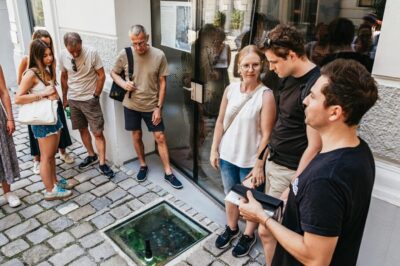
Vienna Historic Center Small Group Walking Tour
Read our review →
Browse the lists this tour appears in