
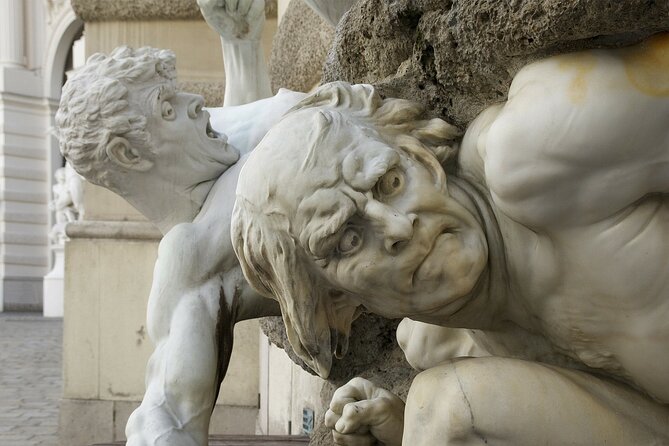
Reviewed · VIENNA OLD TOWN WALKING TOURS
Terrible crimes in Vienna, hidden secrets of the inner city
Vienna’s polished center has another story beneath its imperial façades. This two-hour walk follows murders, torture, espionage, executions, political violence, and strange medical scams through streets you might otherwise pass without a thought. Guide Ben researches the cases himself, giving the tour a personal thread instead of a generic list of old crimes.
I like two things especially: the tour connects crime to Vienna’s political and social past, and it leads you to overlooked corners such as the last traces of the old city wall. The compact route also passes major sights including St. Stephen’s Cathedral, so you get your bearings in the center while hearing stories most standard sightseeing walks skip.
The main consideration is the subject matter. Some stories involve murder, dismemberment, torture, child victims, and executions, so this is aimed at adults and older teenagers, not young children. Fourteen stops in about two hours also means a brisk pace and short explanations at each location.
Key points about Vienna’s darker walking tour
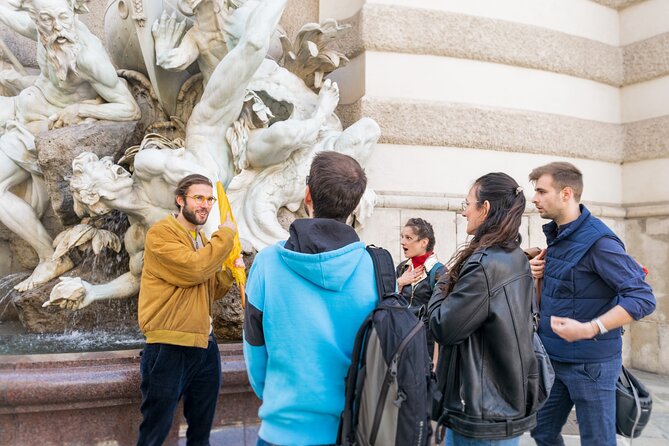
- Fourteen central Vienna locations: The route runs from Helmut-Zilk-Platz through the old center to Rauhensteingasse.
- Crime tied to city history: Cases involving the 1848 revolution, the Habsburg spy service, medieval punishment, and insurance fraud give the tour more context than a simple true-crime walk.
- A personal guide style: Ben is identified as the guide, and the experience places unusual importance on his own research and storytelling.
- Mostly outdoor sightseeing: Each stop is free to access, but the tour focuses on locations and buildings rather than museum admissions.
- English with smartphone support: You receive a complimentary smartphone audio guide, useful if you want to revisit details later.
- Small group size: The maximum is 20 people, enough to keep the walk manageable without promising a private experience.
Why Vienna’s elegant center makes such a good crime walk
Vienna can feel carefully arranged: grand buildings, formal squares, coffeehouses, and the polished streets around the Hofburg. That surface makes the darker stories more striking. A doorway, fountain, or palace façade becomes evidence of an older city where punishment was public, politics could turn violent, and reputations could collapse overnight.
I like this approach because the crimes are not treated as isolated shocks. The stories show how Vienna dealt with monasteries, gossip, class power, military secrecy, religious fear, and political revolt. You get murder, certainly, but you also get a picture of changing law and public attitudes.
The route is almost entirely in the old inner city. Stops last about five to fifteen minutes, with most scheduled for ten. That keeps the walk moving, but it also means you should not expect long lectures or a full legal history of every case.
More old town walks in Vienna:
- Vienna: Guided Walking Tour of City Center Highlights
★ 4.7 · 4,989 reviews - Vienna Historic Center Small Group Walking Tour
★ 5.0 · 1,746 reviews - Vienna: Old Town Sightseeing Tour in a Vintage-Style E-Car
★ 4.5 · 1,107 reviews
From the Capuchin monastery to a ruined acting career
The opening stop at Tegetthoffstraße 2 introduces the Capuchin monastery and its dungeon. Father Innocentius is said to have uncovered cells where monks could be confined for years or even decades. The reasons were sometimes startlingly small, including unauthorized afternoon walks and abuse of a monastery official.
The story becomes larger than the dungeon itself. After Father Innocentius told Emperor Joseph II, the dungeon was closed, and Innocentius was sent to Lviv for his safety. His later life took several turns: he became Protestant, joined the Freemasons, and advised the tsar. That is a strong beginning because it moves from monastic discipline into imperial politics.
At Trattnerhof, the Jaroszynski murder case brings in the actress Therese Krones. Her career was damaged after she became entangled in a case in which she had little real responsibility. Rumors blamed her extravagant wishes for Jaroszynski’s desperation, but the account presented here points instead to his gambling addiction and heavy debts.
This stop should appeal to you if you like the way crime stories expose the power of gossip. The case is not only about who committed a crime. It is also about how quickly a public figure can be blamed when a dramatic story needs a villain.
Bathory, Demel, and Vienna’s grandest scandals
At Augustinerstraße 12, Palais Bathory recalls Elisabeth Bathory, the infamous countess associated with stories of hundreds of murdered young women and bathing in their blood to preserve her youth. The tour presents the central question clearly: was she one of history’s most dangerous killers, or the target of a political plot designed to destroy a difficult and powerful noblewoman?
That uncertainty matters. The Bathory story is famous, but it is also wrapped in sensational claims and political motives. You should expect a dark legend with competing interpretations, not a courtroom verdict delivered with complete certainty.
The stop around Graben and Kohlmarkt shifts from aristocratic crime to modern conspiracy. Demel was connected to Udo Proksch, whose business dealings in the 1970s were tied to the Lucona affair. An overinsured freighter was sent toward Asia with an explosive charge hidden aboard. The resulting conspiracy involved mass murder and major insurance fraud.
This is one of the most useful stops for understanding how the walk reaches beyond medieval and imperial Vienna. It shows that the city’s darker past did not end with public executions. Money, connections, and influence could still delay an investigation in the twentieth century.
Murder, espionage, and the old city’s political nerves
At Ferstel Palace on Herrengasse, the tour points to the former house called Zu den Fünf Morden. It was linked to one of medieval Vienna’s most notorious mass killings, including the murder of a seven-year-old child. The perpetrator was impaled, a punishment considered suitable for a crime viewed as exceptionally terrible.
The execution itself was reportedly prolonged because the executioner lacked experience with this form of death. This is grim material, but it helps explain how medieval justice worked as public theater. Punishment was meant not only to kill the offender, but also to communicate the limits of acceptable behavior.
Across from Palais Ferstel, the former Hotel Klomser marks the end of Colonel Alfred Redl’s espionage scandal. Redl’s suicide followed the discovery of his spying, an affair that damaged the reputation of the Austro-Hungarian army and exposed weaknesses in the underfunded Evidenzbureau, the monarchy’s intelligence service.
I find this case especially valuable because it connects one man’s betrayal to the pressures that helped shape the period before the First World War. The stop is not just about a spy. It is about military confidence, institutional weakness, and the danger of hiding embarrassing facts.
More dark history and ghost walks:
- Vienna: 1.5-Hour Underground Walking Tour
★ 4.9 · 1,146 reviews - Vienna: Ghosts and Legends Guided Nighttime Walking Tour
★ 4.4 · 1,088 reviews - “The Third Man” Film Location Tour
★ 4.9 · 315 reviews - Vienna: Spooky Ghost Tour in English
★ 4.8 · 209 reviews
A dismemberment case and a revolution at Am Hof
At Molker Bastei, you hear the story of Anna Gaugisch, who was killed and dismembered by her boyfriend Raimund Lewisch in 1861. Parts of her body were found in the Danube and in a nearby forge. The account also includes a bizarre detail: Lewisch had been noticed dissecting a cat before the murder.
The case is short, scheduled for five minutes, but it is among the most disturbing stops. Its brevity is probably helpful. You get the essential facts without turning the walk into a long recitation of violence.
At Am Hof, the subject changes from private murder to political killing. War Minister Theodor Baillet de Latour was lynched during the revolutionary upheaval of 1848. The event helped begin Vienna’s October Revolution, the final and more violent phase of the city’s revolt.
The Civil Arsenal is nearby and was looted during the unrest. This is where the tour’s use of place becomes particularly effective. You are not simply hearing that Vienna experienced revolution. You are standing in the area where power, weapons, and public anger collided.
The Hannakenkönig and the business of broken bones
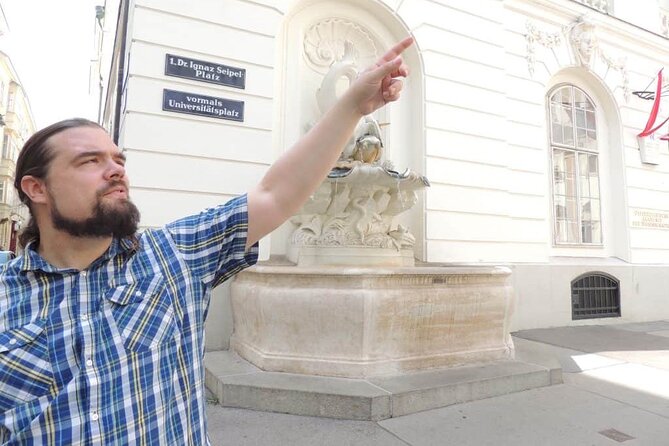
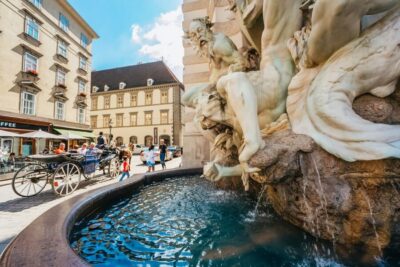
At the Hannaken-Brunnen, the story takes an oddly comic turn before becoming unsettling. The Hannakenkönig was a surgeon accused of creating accidents so he could treat the injuries. He reportedly set up trip hazards, then profited from the broken bones that followed.
The fountain depicts two men carrying an injured companion to the Hannakenkönig. The Hannaken were a minority from Moravia, and many came to Vienna looking for work. That detail gives the stop a social angle. It is not only a tale of a dishonest doctor, but also a glimpse at migration and vulnerable workers in an earlier Vienna.
This is the sort of small, specific story that gives the walk its character. You may not remember every date, but you will remember a surgeon manufacturing business by causing injuries.
Punishment on the city wall and torture at Hoher Markt
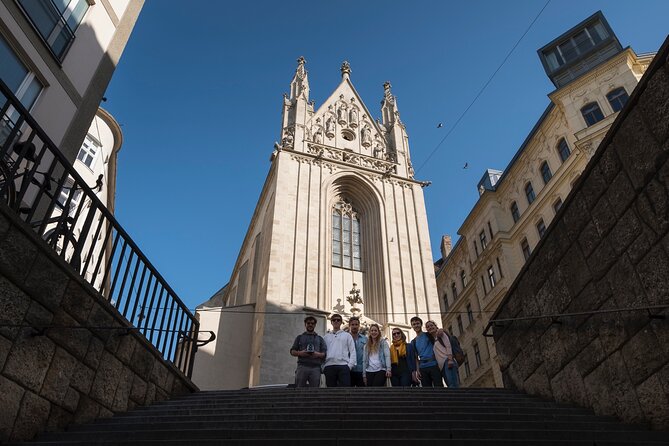
At Maria Am Gestade, the route reaches a surviving section of the city wall associated with the Zahlheim case. The punishment was breaking on the wheel, one of the cruelest forms of execution used for murder. It is particularly striking because the case occurred under Joseph II, who generally opposed the death penalty.
The facts forced him to make an exception. That conflict between a ruler’s stated policy and a brutal individual case gives the stop more weight than a simple description of an old execution method.
Hoher Markt brings the tour to the case of Thekla Riener. Her husband, Anton Grünborn, tortured her with instruments from the courthouse because he believed she had a lover. No such lover existed. His jealousy was built on imagined affairs, and he accidentally killed her. The trauma then drove her parents insane.
This is a powerful reminder that domestic violence is not a modern problem with modern roots. It also shows how legal tools could be misused inside a private obsession. The story is painful, but it adds emotional force to the broader account of justice and power.
St. Stephen’s Cathedral and the baker’s punishment
Near St. Stephen’s Cathedral, the tour examines the supposed standard bread loaf used by Vienna to check bakers’ work. The broader legend claims that bakers who produced poor bread could face a public punishment known as the baptism of bakers.
A baker might be placed in a cage and dipped repeatedly into the Danube. Similar punishments existed in English-speaking countries for women accused of public disputes. The key point is that food quality and public order were once enforced through humiliation and physical danger.
This stop also provides a useful pause from murder cases. Vienna’s dark past included everyday regulation, trade rules, and public shaming, not only sensational crimes.
Witches, forbidden love, and the route’s final stories
At Steffl, the former Malefizspitzbubenhaus held an executioner’s apartment and dungeon. It was also where Plainacher, the only person burned as a witch in Vienna, was imprisoned and tortured.
Plainacher was accused of bewitching her epileptic granddaughter and summoning demons. Witch persecution was not common in Vienna, but pressure from the public helped force the city judge to act. This story shows how fear could push authorities toward a punishment they might otherwise avoid.
The last stop at Himmelpfortgasse recalls the former Himmelpfort monastery. In 1319, a nun was walled in because she refused to abandon the man she loved. Her father opposed the relationship, so he condemned her to a convent life instead of accepting the match.
It is a Viennese version of a forbidden-love story, with a mayor and his political enemy replacing the feuding families of a play. Ending on this note gives the walk a change of mood. Not every story is about a killer. Some are about family power, social control, and the terrible cost of obedience.
What the pace, price, and group size mean
The price is $46.13 per person. Since the tour lasts about two hours and covers 14 locations, you are paying mainly for the guide’s research, structure, and interpretation rather than entrance tickets. Every listed stop is free to access, so the value depends on how much you want a specialist narrative instead of wandering through the same streets alone.
For me, the price makes the most sense if you enjoy both true crime and urban history. The tour also works well beside Vienna’s Crime Museum, since the walk gives you outdoor context and links individual cases to the city’s changing laws and politics.
The group can reach 20 people. That is still a reasonable maximum for a central-city walk, though you should not expect the intimacy of a private tour unless the booking happens to be small. The experience is offered in English and includes a complimentary smartphone audio guide, which gives you another way to follow or recall the material.
The start is at Helmut-Zilk-Platz, near Albertinaplatz. The walk ends on Rauhensteingasse. Both points are in Vienna’s first district, near public transportation, but you should allow a few minutes to find the exact starting point.
Good weather is required. If poor weather cancels the experience, you are offered another date or a full refund. You can also cancel for a full refund up to 24 hours before the start time. The activity requires a minimum number of bookings, so a cancellation is possible if that number is not reached.
Who should book this Vienna walking tour?
I would choose this walk if you want Vienna to feel less polished and more human. It is especially suited to adults, older teenagers, history fans, true-crime followers, and people who have already seen the main palaces and want a different way to read the center.
It also suits locals. The route has enough unusual material to make you feel like a tourist in your own city, even if you have lived in Vienna for years. The transitions between stops are carefully arranged, so each story leads naturally to the next rather than feeling like fourteen unrelated facts.
I would skip it if you dislike gruesome subjects, want to enter major monuments, or prefer a slow architectural walk. The route is outdoor-focused, the schedule is tight, and several cases involve torture, child victims, sexual violence, execution, and murder.
Should you book Terrible Crimes in Vienna?
Book it if you want a brisk, unusual walk that uses crime to explain Vienna’s institutions, streets, scandals, and past punishments. Ben’s research and storytelling are the main reason to choose it, while the route’s overlooked walls, fountains, courtyards, and former prisons give you places you may not find alone.
At $46.13, it is not the cheapest way to walk through the first district, since the sites themselves cost nothing. But if you would otherwise spend hours piecing together obscure cases from plaques and guidebooks, the fee buys a focused story with a clear route. Bring an open mind, expect dark material, and let Vienna’s grand center reveal its less comfortable side.
FAQ
Where does the tour start?
It starts at Helmut-Zilk-Platz, Albertinaplatz 2-3, 1010 Vienna, Austria.
Where does the tour end?
The tour ends on Rauhensteingasse in Vienna’s first district.
How long does the tour last?
It lasts approximately two hours.
What language is the tour offered in?
The tour is offered in English.
How much does the tour cost?
The listed price is $46.13 per person.
Is a smartphone audio guide included?
Yes. A complimentary smartphone audio guide is included.
How many people can join the tour?
The maximum group size is 20 people.
Are admission tickets included?
The listed stops have free admission. This is primarily an outdoor walking tour of streets, squares, buildings, fountains, and former sites.
Is the tour suitable for children?
The tour contains gruesome crimes, torture, executions, and murder. It is more suitable for adults and older teenagers than for young children.
Can I cancel for a full refund?
Yes. You can cancel at least 24 hours before the start time for a full refund. Poor weather or failure to meet the minimum number of bookings can also lead to a different date or a full refund.
Just reviewed in Vienna
- World War II History Vienna Old Town Private Walking Tour★ 4.8 · 9 reviews
- Vienna: Wine Tasting E-Bike Tour★ 4.9 · 46 reviews
- Vienna: Winery and Wine Tasting Tour with a Wine Expert★ 5.0 · 5 reviews
- Vienna: Unforgettable Private City Tour★ 5.0 · 7 reviews
- Vienna Urban Art Tour: Explore a different side of Vienna!★ 3.8 · 14 reviews
- Vienna: Concert by the Vienna Baroque Orchestra★ 4.6 · 56 reviews
- Vienna: Sunday Brunch Danube Cruise & Live Music★ 4.2 · 42 reviews
- Vienna Supreme Orchestra at Palais Niederösterreich★ 4.8 · 10 reviews
Vienna Old Town Walking Tours, compared.
Vienna Historic Center Small Group Walking Tour
Read our review →
Exclusive Vienna Old Town Highlights Walking Tour (max. 6 persons)
Read our review →
Browse the lists this tour appears in