
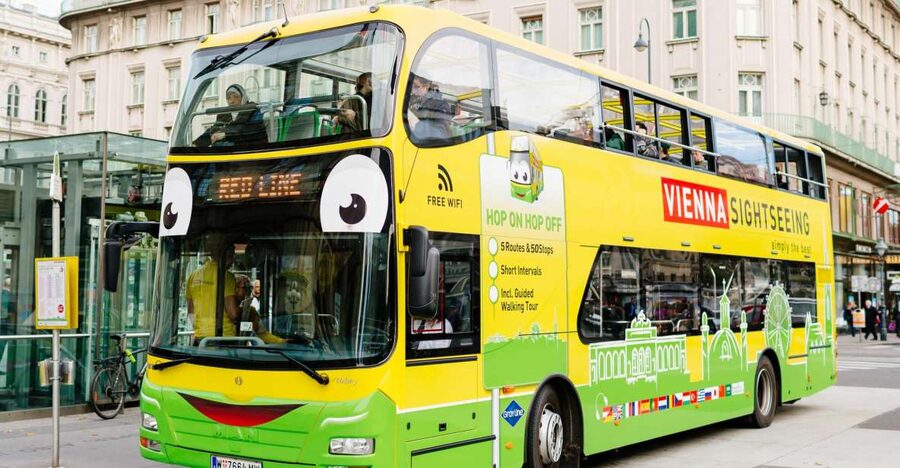
Reviewed · VIENNA HOP-ON HOP-OFF BUS TOURS
Vienna: Hop-On Hop-Off Sightseeing Bus Tour in 19 Languages
Vienna’s hop-on hop-off bus is at its best when you use it as a sightseeing framework, not simply as a ride. The four-route network reaches Schönbrunn, Belvedere, the Prater, the Ring Road, and, in summer, the vineyards around Grinzing and Cobenzl. You can get your bearings first, then return to the places that deserve more time.
I like the clear audio commentary, which includes 19 languages and a children’s channel in German and English. I also like the practical frequency: buses run about every 20 minutes on the Blue Route and every 20 to 30 minutes on the central routes. The main drawback is the limited operating day, usually ending between 5:00 and 5:30 PM, while the summer Green Route comes only once an hour.
Key points to know before you board

- Four distinct routes: The Red Route circles central Vienna, the Yellow Route reaches Schönbrunn and Belvedere, the Blue Route heads toward the Prater and Danube, and the Green Route reaches Grinzing in summer.
- Best for first-time visitors: You can see a wide stretch of Vienna quickly and mark places for a later visit.
- Audio in 19 languages: English, German, French, Spanish, Italian, Arabic, Chinese, Japanese, Korean, Polish, Serbian, and more are available.
- Schönbrunn takes about 35 minutes: That is the approximate ride from the State Opera, making the Yellow Route useful for connecting the center with the palace.
- The Green Route is seasonal: It is included with 24, 48, and 72-hour tickets, but it does not operate year-round.
- Bring your own sightseeing plan: Palace and museum admission are not included, so use the bus to reach sights, then budget extra time and money for entry.
What the Vienna bus tour really gives you
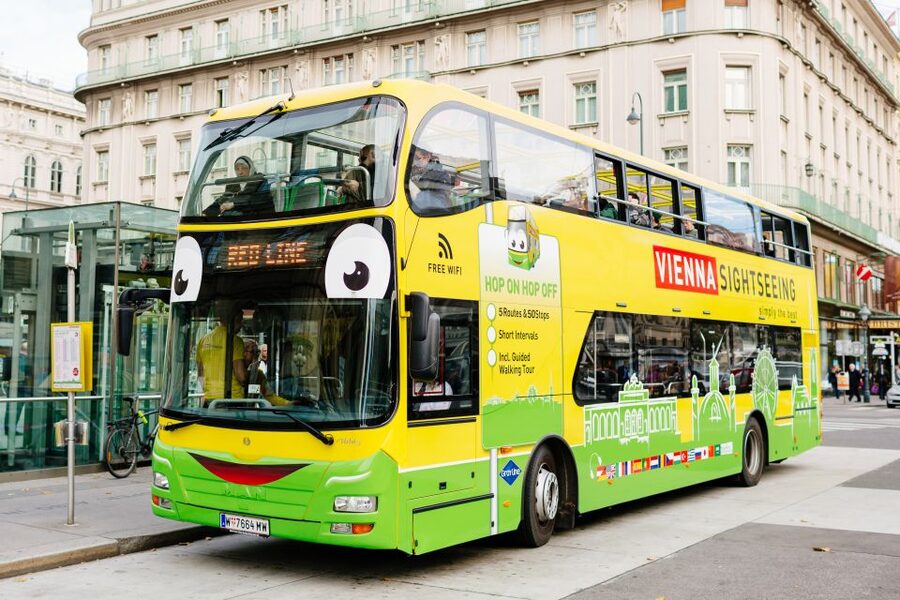
The central benefit is simple: you can cover a large city without constantly checking tram connections or walking between far-flung sights. Vienna is easy to explore by public transport, but the bus adds orientation and commentary. You sit above street level, listen to an explanation of the buildings outside, and decide where to get off.
This matters most on a short stay. A 24-hour ticket can give you a broad introduction to Vienna, although you need to begin early and use the routes efficiently. A 48-hour or 72-hour ticket gives you more breathing room. You can spend one day learning the city, another visiting Schönbrunn or Belvedere, and a third returning to museums and neighborhoods that caught your attention.
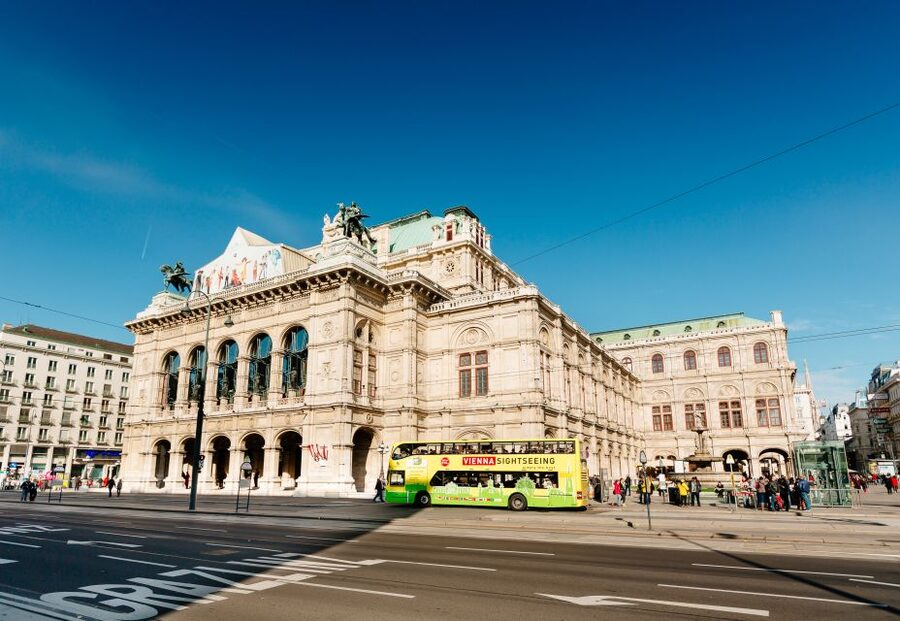
The system is built around the State Opera, where several routes meet. You can also board at stops such as Vienna Central Station, Westbahnhof during the operating season, Schönbrunn, Belvedere, the Prater, or the Museum of Applied Arts. Look for the yellow buses and Vienna Sightseeing Tours signs, then show your voucher to a representative to receive your ticket.
More sightseeing tours of Vienna:
- Vienna PASS: All incl. Sightseeing Pass for 85+ Attractions
★ 4.3 · 3,067 reviews - Vienna: Guided Walking Tour of City Highlights & Hidden Gems
★ 4.9 · 2,180 reviews - Big Bus Vienna Hop-On Hop-Off Sightseeing Tour
★ 4.0 · 1,735 reviews
Red Route: Vienna’s Ring Road in one hour
The Red Route is the best first ride. It takes about 60 minutes for the full circuit, with buses arriving roughly every 30 minutes between 9:30 AM and 5:30 PM.
The route begins at the State Opera, a useful central meeting point, then follows the Ring Road past the Museum of Art History, Heldenplatz, the Hofburg, Mariahilfer Straße, the Burgtheater, Vienna City Hall, the University, and the Votive Church. This is Vienna’s grand civic face: imperial buildings, museums, formal squares, and wide avenues.
The audio commentary helps you place the buildings in context, and each stop is clearly announced. That makes the Red Route particularly useful if you are still learning the city’s layout. You can get off at the Museum of Art History and Heldenplatz, walk toward the Hofburg, or stop near the Burgtheater and City Hall.
The route also reaches the Sigmund Freud Museum area, the Danube Canal cruise stop, the Museum of Applied Arts, and Stadtpark. At Stadtpark, you can walk toward the famous Strauss monument before catching another bus.
My advice is to ride the Red Route once without getting off, then use it as a connector later. If you stop at every museum, the half-hour wait between buses can eat up your day. The route is excellent for orientation, but it is not designed to replace time on foot.
Yellow Route: Schönbrunn and Belvedere
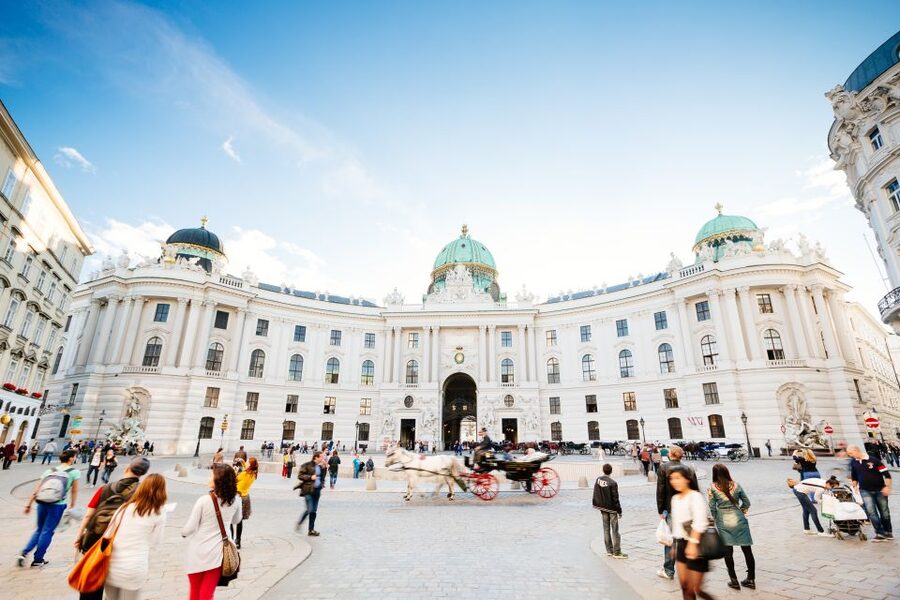
The Yellow Route is the practical choice for Vienna’s two major palace stops. A full circuit takes about 90 minutes, with buses arriving every 20 to 25 minutes from around 9:15 AM to 5:15 PM.
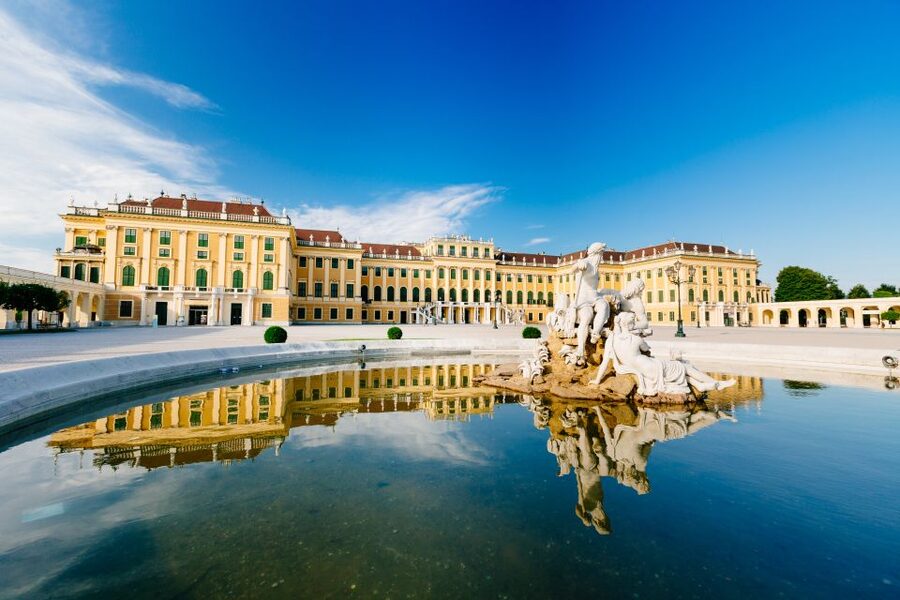
From the State Opera, the bus passes Westbahnhof and reaches Schönbrunn Palace in about 35 minutes. That direct ride saves you from arranging a separate connection from the center. Schönbrunn deserves more than a quick photograph. The palace interiors, grounds, and views can easily take several hours, and admission is not included in this bus ticket.
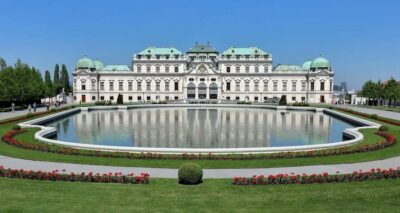
The route continues toward Vienna Central Station, the Museum of Contemporary Art, and Belvedere Palace. Belvedere is known for its palace setting and art collections, and it is easier to fit into a day when you can travel directly from the center or from the station area.
Lower Belvedere is also a stop. Check the exact stop you need before getting off, since the Upper and Lower Belvedere are separate parts of the complex. The Yellow Route then returns to the State Opera.
I would reserve a full morning for Schönbrunn and use the Yellow Route again later for Belvedere. Trying to visit both palaces, enter their museums, and complete the rest of the routes in one day will feel rushed. The bus gives you convenient transport, but it cannot shorten the time needed to see the palaces properly.
Blue Route: the long ride to the Prater and Danube
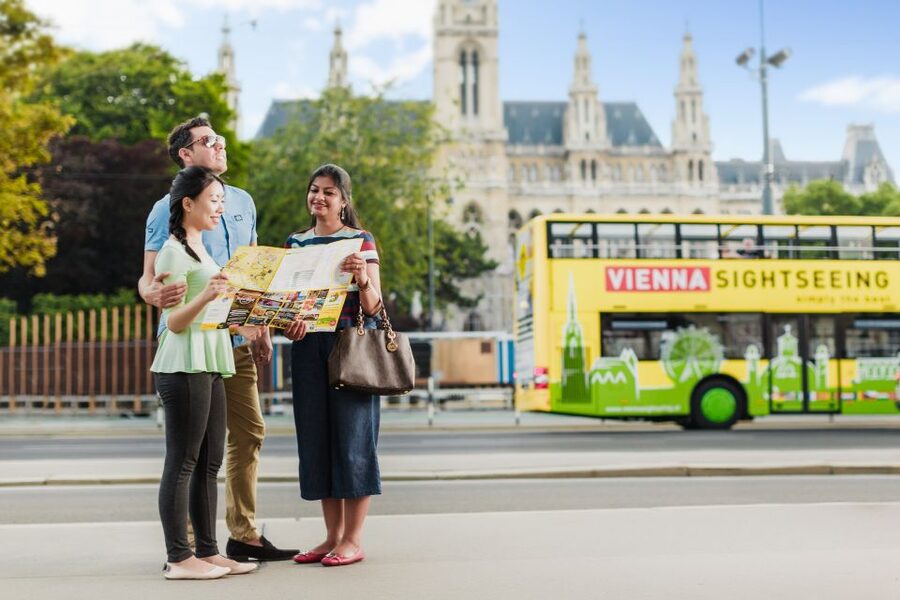
The Blue Route is the longest and most varied. The full circuit takes about two hours, and buses arrive approximately every 20 minutes from 9:30 AM to 5:00 PM.
It includes many of the Red Route’s central stops, including the State Opera, Heldenplatz, Mariahilfer Straße, City Hall, the University, the Votive Church, and the Museum of Applied Arts. Then it heads farther east toward the KunstHausWien and the Prater.
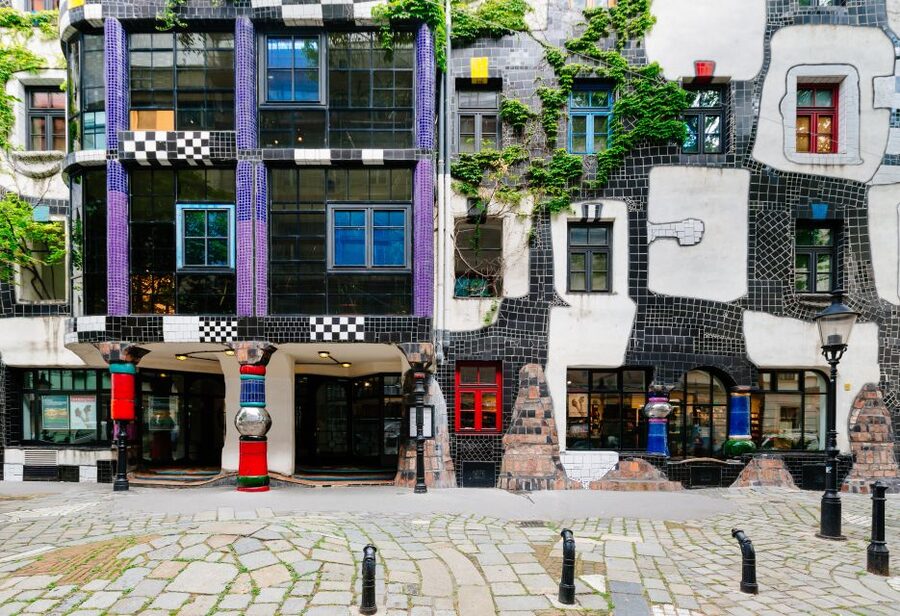
The KunstHausWien and Hundertwasser Museum are worthwhile stops if you enjoy unusual architecture and art. The route also reaches the Giant Ferris Wheel, one of the best-known symbols of the Prater. You can get off here for the amusement park area and then continue toward Praterstern and Taborstraße.
Beyond the Prater, the route reaches the Danube Tower, Old Danube, UNO City, Danube Island, and the Imperial Bridge area. These stops show you a less imperial side of Vienna, with modern international buildings, water, parks, and large open spaces.
The Blue Route requires careful timing. Since the complete circuit is long, getting off in the afternoon can leave you waiting for the next bus or returning later than planned. Use the live GPS tracking on the website, and check the final departure times before heading far from the center.
More hop-on hop-off bus tickets:
- Vienna: Big Bus Hop-On, Hop-Off Tour by Open-Top Bus
★ 4.4 · 3,529 reviews - Vienna Hop On Hop Off City Tour
★ 3.5 · 884 reviews - Vienna PASS Including Hop On Hop Off Bus Ticket
★ 4.0 · 405 reviews - Vienna: Big Bus City Highlights Night Tour with Live Guide
★ 4.1 · 375 reviews
Green Route: Grinzing and Cobenzl in summer
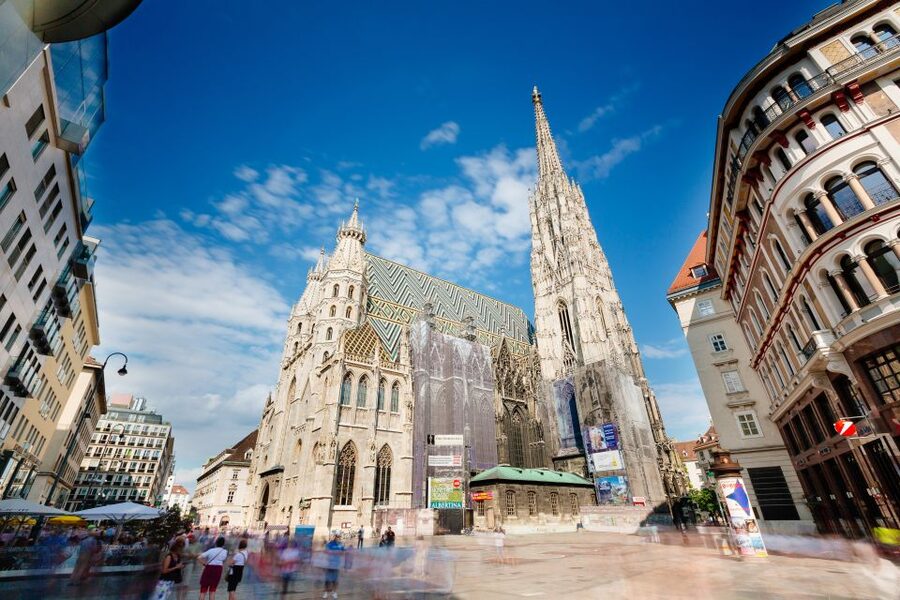
The Green Route operates only in the summer months and is included with 24, 48, and 72-hour tickets. Buses run about once an hour from roughly 10:45 AM to 4:00 PM, and the full ride takes about an hour.
This route heads toward Grinzing and Cobenzl, areas known for views over Vienna and a more rural edge to the city. The panoramic outlook is the main reason to make the trip. It gives you a change from palaces, museums, and broad city avenues.
The hourly schedule is the catch. You need to watch the clock, especially if you get off at Cobenzl. Missing a bus can leave a long gap, and one visitor found it necessary to use public transport after reaching the viewpoint. Check the live tracking and plan your return before leaving the bus.
If the weather is clear, the Green Route can be the most memorable addition to the standard city circuit. If clouds are low or your stay is short, give priority to the Red, Yellow, and Blue routes.
Audio commentary, Wi-Fi, and the walking app
The audio guide is available in 19 languages: German, English, Italian, French, Spanish, Portuguese, Dutch, Romanian, Czech, Hungarian, Turkish, Greek, Russian, Japanese, Chinese, Serbian, Korean, Polish, and Arabic.
That language range is one of the strongest reasons to choose this service. The commentary covers history, buildings, and people connected with Vienna, and the timing generally matches what you are passing. Classical music is also used between sections, which suits the city without turning the ride into a lecture.
A children’s commentary channel is available in German and English. Free Wi-Fi is provided on all buses, and GPS live tracking is available through the website. The service also includes a self-guided walking tour app called QuietVox. You pick up headphones and a map at the local partner’s service center, then follow the route between the State Opera, the Beethoven Statue, the Vienna Concert House, the House of Music, and the Beethoven Museum.
The walking tour is useful because Vienna cannot be understood from a bus window alone. Get off, walk a few blocks, and look up at the details around the Ring Road. The bus gets you between areas; your feet provide the real sense of the city.
How to get the best value from $41
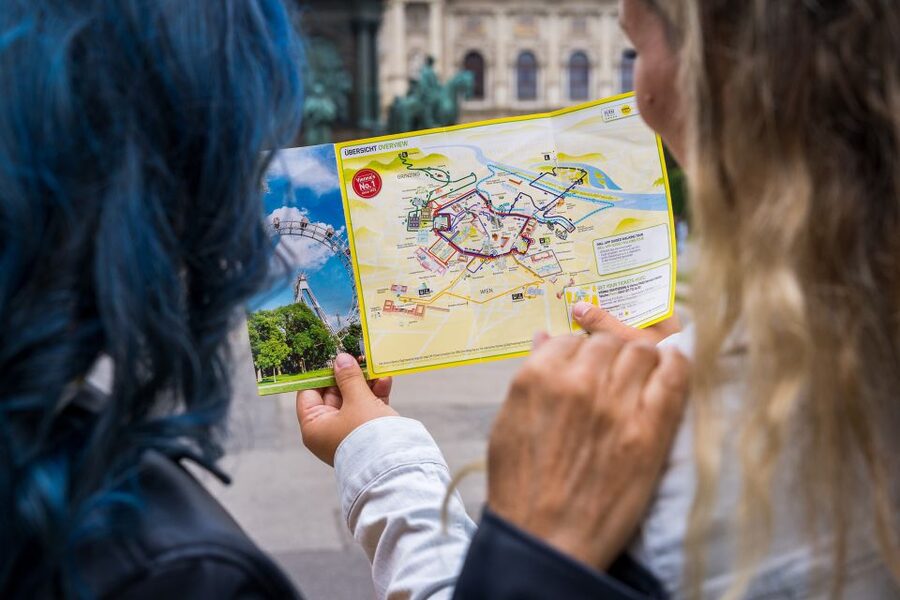
At about $41 per person, the ticket is not automatically a bargain for someone who plans to walk central Vienna and visit only one sight. Vienna’s center is compact, and many major buildings sit close together.
The value improves if you use two or more routes, travel to Schönbrunn, and take advantage of the ticket for more than one day. A 72-hour pass can work especially well if you want to combine transport, orientation, and repeated sightseeing without buying separate connections each time.
A simple plan works well:
- First morning: Ride the Red Route to understand the central districts.
- First afternoon: Get off near the Hofburg, Museum of Art History, or City Hall.
- Second day: Use the Yellow Route for Schönbrunn and Belvedere.
- Third day: Take the Blue Route to the Prater, KunstHausWien, and the Danube area.
- Summer option: Add Grinzing and Cobenzl if the weather is clear and the hourly schedule fits.
A 24-hour ticket can still be worthwhile, but start early. Operating hours end in the late afternoon, and one day is not enough for a relaxed visit to every major stop. The bus is most useful as a time-saving tool, not as a substitute for entering the museums and palaces.
Timing, comfort, and small practical drawbacks
Buses are described as clean and comfortable, with windows that can be adjusted for changing weather and a covered roof. Drivers and staff are generally helpful, and representatives are stationed at key stops to direct you to the correct route.
The central stop near the State Opera is the easiest place to change between lines. Vienna Central Station can also be useful, especially if you arrive by train. Westbahnhof may operate only during the summer season, so do not assume that stop is available in winter.
Service is generally predictable, but the timetable matters. Red buses every 30 minutes are fine for a full circuit, less so if you get off for a short museum visit. The Green Route’s 60-minute interval needs even more planning. Some departures may also finish earlier than you expect, so keep an eye on the last bus.
Smoking and pets are not allowed, although assistance dogs are permitted. Entrance fees to museums, palaces, and other attractions are separate.
Who should book this Vienna sightseeing bus
I would recommend this tour to first-time visitors, families, people with limited time, and anyone who wants an easy first look before choosing which sights deserve admission fees. It also suits solo visitors who prefer a simple route with multilingual commentary.
It is less useful if you already know Vienna well, plan to spend most of your time inside museums, or prefer local trams and walking. The bus does not take you everywhere, and waiting for the next departure can be slower than using the city’s regular transport.
The strongest approach is to use it for orientation and long connections, then walk once you reach the historic center. That gives you the comfort of an organized route without missing Vienna’s street-level details.
Should you book it?
Book this Vienna hop-on hop-off tour if you want to see the city’s major districts in one to three days, especially if Schönbrunn, Belvedere, the Prater, and Grinzing are all on your list. The multilingual audio, free Wi-Fi, live tracking, and wide route network add real practical value.
Choose the 24-hour option for a fast overview. Pick 48 or 72 hours if you want to visit palaces and museums without racing the timetable. I would not buy it simply to sit on a bus all day, but as a sightseeing base for a first Vienna visit, it is a sensible and flexible choice.
FAQ
How long is the Vienna hop-on hop-off ticket valid?
You can choose a 24-hour, 48-hour, or 72-hour ticket, depending on the option booked.
How many bus routes are included?
The ticket provides access to up to four routes: Red, Yellow, Blue, and the seasonal Green Route.
Is the Green Route available all year?
No. The Green Route operates during the summer months only.
What does the Green Route visit?
It travels toward Grinzing and Cobenzl, where you can enjoy panoramic views over Vienna.
How often do the buses run?
The Red Route runs about every 30 minutes, the Yellow Route every 20 to 25 minutes, the Blue Route every 20 minutes, and the Green Route about every 60 minutes.
How long does the Red Route take?
The complete Red Route takes about 60 minutes.
How long does the Yellow Route take to complete?
The full Yellow Route takes about 90 minutes. The ride from the State Opera to Schönbrunn takes approximately 35 minutes.
Is audio commentary included?
Yes. Audio commentary is available in 19 languages, including English, German, Spanish, French, Polish, Korean, Serbian, and Arabic.
Is there a children’s audio channel?
Yes. A children’s commentary channel is available in German and English.
Are palace and museum entrance fees included?
No. The bus ticket covers the sightseeing routes, but admission to attractions is separate.
Just reviewed in Vienna
- World War II History Vienna Old Town Private Walking Tour★ 4.8 · 9 reviews
- Vienna: Wine Tasting E-Bike Tour★ 4.9 · 46 reviews
- Vienna: Winery and Wine Tasting Tour with a Wine Expert★ 5.0 · 5 reviews
- Vienna: Unforgettable Private City Tour★ 5.0 · 7 reviews
- Vienna Urban Art Tour: Explore a different side of Vienna!★ 3.8 · 14 reviews
- Vienna: Concert by the Vienna Baroque Orchestra★ 4.6 · 56 reviews
- Vienna: Sunday Brunch Danube Cruise & Live Music★ 4.2 · 42 reviews
- Vienna Supreme Orchestra at Palais Niederösterreich★ 4.8 · 10 reviews
Vienna Hop-On Hop-Off Bus Tours, compared.

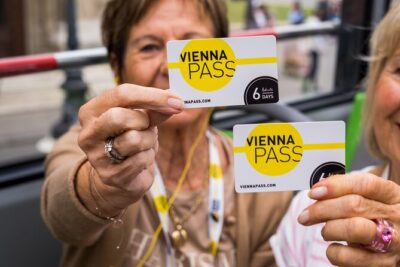
Vienna PASS Including Hop On Hop Off Bus Ticket
Read our review →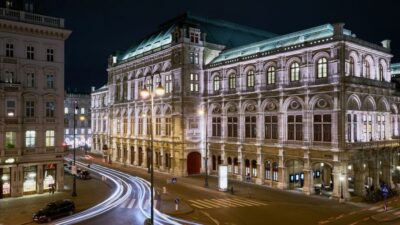
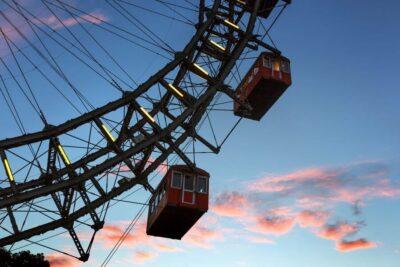
24-hour Hop-On Hop-Off with Ferris Wheel and River Cruise
Read our review →
Best of Vienna Pass: Schönbrunn, Belvedere, Big Bus & Cruise
Read our review →Browse the lists this tour appears in