
Reviewed · VIENNA CHURCH TOURS AND TICKETS
Day Ticket for Klosterneuburg Abbey
Klosterneuburg Abbey packs 900 years of Austrian history into a visit just minutes from Vienna. You can move from medieval art to grand Habsburg rooms, then finish in a Baroque wine cellar with local wine. It is a fine change of pace from Vienna’s city museums.
I like the Verdun Altar, one of the abbey’s great artistic treasures, and the broad views toward the Danube and Vienna. I also like that the admission can cover far more than a church visit, including the Treasury, Marble Hall, Imperial Apartments, and winery.
The main point to check is the language and format of the guided visit. The experience is offered in English, but one visit used a German guide with English audio material. The guide added useful details, but you should confirm what is running on your chosen date.
Key points at a glance
- The Verdun Altar is the artistic centerpiece, with medieval enamel work and remarkable surviving glass windows.
- The Treasury and museum areas are carefully presented, giving you more than a quick look inside a church.
- The Marble Hall and Imperial Apartments show the abbey’s grand side, with a very different mood from the older religious rooms.
- The Danube views reach toward Vienna, giving you a strong sense of the abbey’s setting above the city.
- The winery adds a distinctly Austrian finish, with a Baroque cellar and selected local wines.
- The visit can take from one to three hours, so you can fit a short look into a Vienna day or make it a substantial half-day outing.
A 900-year-old abbey close to Vienna
Klosterneuburg Abbey is a useful choice when you want history without spending the entire day in central Vienna. Its location makes it feel like an outing, yet the visit is short enough to fit around other plans.
The abbey’s story reaches back more than nine centuries. That long span is what gives the visit its variety. You are not seeing one perfectly unified building from one period. You are moving through religious, imperial, artistic, and wine-making chapters that accumulated over time.
I find that kind of place more rewarding than a single-period monument. One room may focus on medieval craftsmanship, while the next shows the wealth and ceremony of later rulers. The change in mood helps you understand how the abbey developed.
Plan on one to three hours, depending on how much of the complex is open as part of your visit and how carefully you study the displays. A quick visit can cover the main highlights. If you want time for the Treasury, historic rooms, church, views, and winery, allow closer to the longer end.
More churches and crypts in Vienna:
- Vienna: Vivaldi’s Four Seasons Concert in Karlskirche
★ 4.7 · 14,951 reviews - Vienna: Light of Creation Votive Church Immersive Light Show
★ 4.8 · 6,779 reviews - Vienna: Classic Ensemble Vienna in St. Peter’s Church Ticket
★ 4.7 · 4,819 reviews
The abbey church and the Verdun Altar
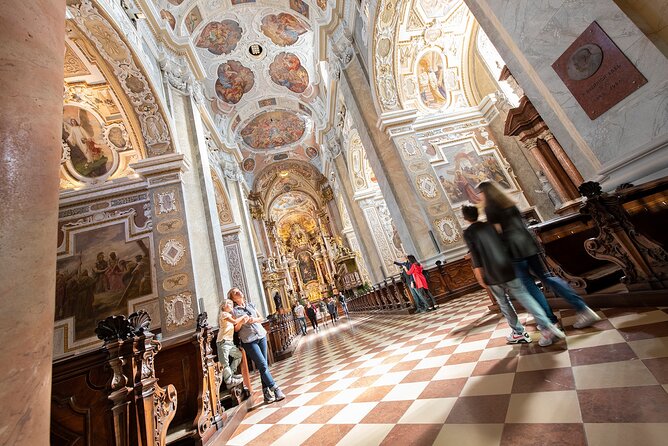
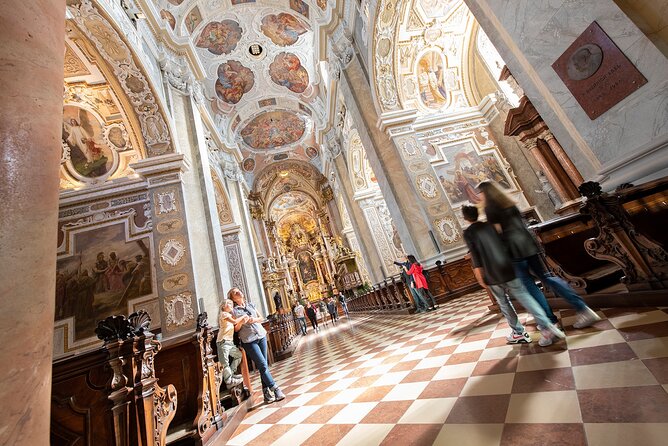
The abbey church is one of the essential parts of the visit. Even if your main interest is art or architecture, the church gives you the setting needed to understand the abbey as a working religious foundation rather than only a museum.
The major prize is the Verdun Altar. It is famous for its medieval enamel panels, and it deserves unhurried attention. Small works of medieval art often look simple from a distance, but the details become clearer when you take time to examine the surfaces and figures.
The surviving glass windows also deserve notice. Their preservation adds another layer to the visit, especially for anyone who enjoys religious art and medieval craftsmanship. A guide can help point out details that are easy to miss when you are moving through on your own.
One reported guided visit was conducted in German, with English audio material provided. The guide added information beyond the audio program, which is useful if you want extra context but are not comfortable following a German explanation. Since the exact arrangement may vary, check the language setup before booking.
The Treasury and museum displays
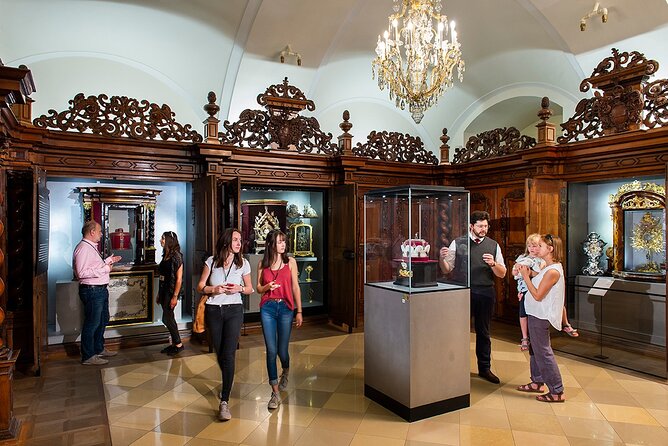
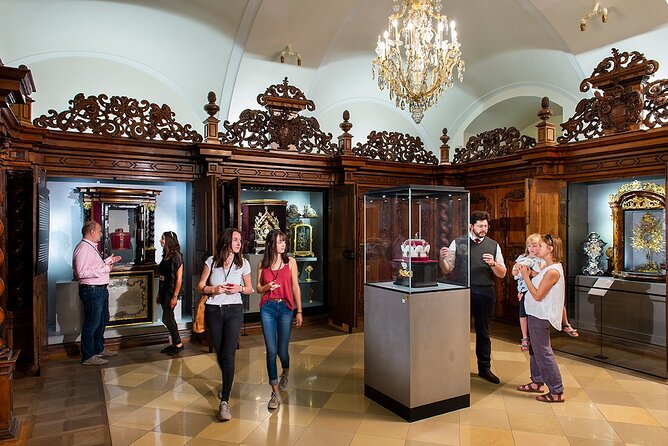
The Treasury gives the visit its most direct encounter with precious religious objects and works of art. The displays are presented as a quality museum area, not simply as items placed around an old building.
That matters because the abbey contains a lot to take in. Without good presentation, a collection of church objects can blur into a long row of cases. Here, you can give the Treasury proper attention and then connect what you see with the abbey church and its religious purpose.
I would make this section a priority even if you have only an hour. The combination of art, devotion, and institutional wealth tells you a great deal about the role an abbey could play over many centuries.
The Treasury is also a good reason to avoid rushing straight to the views or wine cellar. Those are memorable parts of the visit, but the art collection is one of the strongest reasons to come in the first place.
Marble Hall and Imperial Apartments
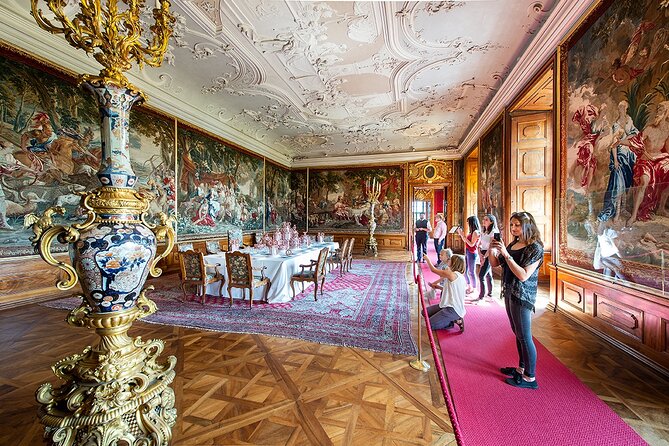
The Marble Hall shifts the tone from medieval religious art to ceremonial architecture. Its scale and decoration show the abbey’s grander side, and it helps explain how religious institutions could also serve as places of power and formal display.
The Imperial Apartments add another layer. You are no longer looking only at worship and monastic life. These rooms connect the abbey with Austria’s ruling world and with the people who used or visited such grand spaces.
I like this contrast because it keeps the visit from becoming one-note. The older art has intimacy and fine detail. The Marble Hall and Imperial Apartments give you size, polish, and a sense of ceremony.
You may find that the historic rooms are especially useful if you are already visiting Vienna’s palaces. They provide another view of the same broad culture of imperial Austria, but in an abbey setting rather than a city residence.
A few more Vienna outings worth weighing up
- Vienna Kunsthistorisches Museum Day Admission Ticket
★ 4.6 · 3,690 reviews - Vienna: Tickets for Mozarthaus Vienna with Audio Guide
★ 4.2 · 2,344 reviews - Vienna: Skip-the-Line Entrance Ticket to the Danube Tower
★ 4.5 · 2,303 reviews - Tickets for the Albertina Exhibitions
★ 4.7 · 2,126 reviews
The Danube and Vienna views
The views are one of the easiest rewards to appreciate. From the abbey, you can look across the Danube and toward Vienna. After spending time indoors with altars, relics, and historic rooms, the open outlook gives you a welcome pause.
The view also makes the location easier to understand. Klosterneuburg is not an isolated monument with no connection to the capital. You can see how close it is to Vienna while still feeling removed from the city’s busy center.
Take a moment here even if you are mainly interested in art. The view helps place the abbey in its regional setting, and it gives the visit a natural break between interior rooms.
The information provided does not specify a dedicated viewing platform or exact direction within the grounds, so treat the panorama as part of the abbey visit rather than planning your entire outing around one particular lookout.
Austria’s oldest winery and the Baroque cellar
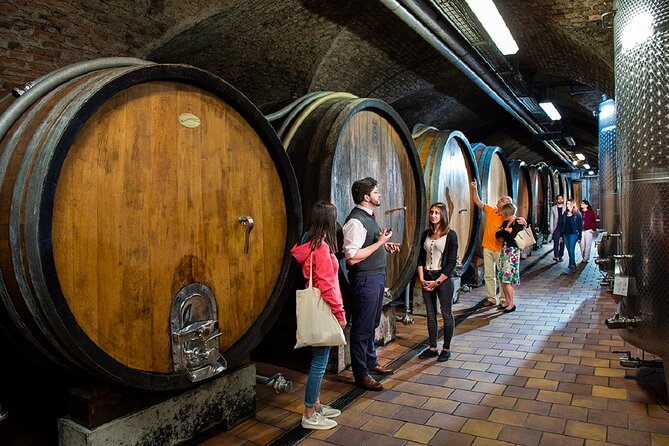
The winery is the abbey’s most distinctive extra attraction. It is described as Austria’s oldest winery, and the cellar has a striking Baroque design. This gives you a direct link between the abbey’s religious foundation and its long wine-making tradition.
The wine cellar should appeal even if you are not a serious wine student. It changes the pace of the visit and gives you something tangible to connect with local culture. Wine is not an afterthought in Austria, and a historic cellar makes that tradition easier to appreciate.
Selected local wines are included as part of the available winery experience. The supplied information does not specify the exact number of pours or the precise tasting format, so do not book solely on the assumption of a large tasting session. Think of it as a compact cultural addition to the abbey visit.
If you do not drink wine, the cellar and architecture may still be worth seeing. If wine is a major interest, check whether the tasting is included in your selected admission option and ask about the day’s format.
How much time should you allow?
The official duration is flexible, from one to three hours. That range is useful, but it also means you should decide in advance what kind of visit you want.
For a short visit, focus on the church, Verdun Altar, Treasury, and one or two major rooms. You will get the central artistic and historical story without trying to inspect every display.
For a fuller visit, allow up to three hours. That gives you time for the church, Treasury, Marble Hall, Imperial Apartments, views, and winery. You can also pause when the guide or audio material explains an object in more detail.
Do not schedule the abbey so tightly that you have to leave after 45 minutes. The experience works best when you allow the building’s contrasts to register. Medieval art, imperial rooms, and a Baroque cellar need different kinds of attention.
Is the $24.06 price good value?
At $24.06 per person, the ticket offers reasonable value if you use it as a broad abbey visit rather than paying only for a quick church entry. The price becomes more attractive when the Treasury, church, historic rooms, views, winery, and wine tasting are all part of your selected experience.
The value depends on your interests. If you enjoy art, architecture, church history, and historic interiors, you can fill two or three hours without trouble. If you want only a scenic stop and a fast look inside, the ticket may feel less compelling.
I would compare it with the cost of another major Vienna attraction and ask how much time you want outside the city center. This is not just a standard museum room. It gives you a wider mix of art, architecture, history, and local wine culture.
The flexible length also helps. You do not have to turn it into a full day. A one-hour visit can work as a focused stop, while a longer stay gives the price more weight.
Getting there and planning the visit
The available information says the abbey is near public transportation, which makes it practical for a visit from Vienna. It does not provide a specific route, station, or transfer instructions, so check the current public transport details before you leave.
Opening hours change by season:
- From January 1 through April 30, the abbey is open daily from 10:00 a.m. to 4:00 p.m.
- From May 1 through November 15, it is open daily from 9:00 a.m. to 6:00 p.m.
The longer warm-season hours make it easier to fit the abbey into a day trip. The shorter winter and early spring hours call for more planning, especially if you want the full three-hour experience.
The provided schedule ends on November 15, so confirm the operating calendar for dates outside that period. Opening hours alone do not tell you which guided tours, audio options, or winery elements are running at a given time.
The attraction is available in English, but the language of a particular guided tour may vary. If you need English instruction, verify whether you will receive an English guide, an English audio program, or both.
Who will enjoy this visit most?
I would recommend Klosterneuburg Abbey to you if you want a break from Vienna’s central museums and prefer a place with several kinds of history in one setting. Art lovers will find the Verdun Altar and Treasury worthwhile. Architecture fans will enjoy the church, Marble Hall, and Imperial Apartments.
It also suits wine-minded visitors who want a cultural setting around their tasting. The cellar adds a local touch that a standard palace tour cannot provide.
Families and mixed-interest groups may find the variety helpful. One person can focus on medieval art, another on imperial rooms, and another on wine and views. The only caution is that the visit involves historic interiors and museum displays, so a moderate level of physical fitness is recommended.
Service animals are allowed. The site is near public transportation, but the provided details do not describe every surface, stairway, or interior access point, so ask the abbey directly if you have specific mobility needs.
Booking, cancellation, and practical cautions
Confirmation is provided at the time of booking. Free cancellation is available if you cancel at least 24 hours before the experience’s start time.
Inside the 24-hour window, you should expect no refund, and changes made during that period are not accepted. The cut-off follows local time in Austria, so use the local start time when counting backward.
This experience is often booked well in advance, with an average booking lead time of about 40 days. That does not prove every date sells out, but it is a useful signal if you are visiting Vienna during a busy period or need a particular English option.
Should you book Klosterneuburg Abbey?
Book it if you want more than a single historic room. The Verdun Altar, Treasury, Marble Hall, Imperial Apartments, Danube views, and old winery create a varied visit close to Vienna. At $24.06, the price is fair when you allow enough time to use the full range of included sights.
I would be more cautious if you have only a brief stop in Vienna, dislike church art and historic interiors, or want a clearly defined English guided tour. In that case, confirm the language arrangement before paying.
For most visitors with half a day to spare, this is a sensible addition to a Vienna itinerary. Give it two to three hours, check the seasonal schedule, and treat the wine cellar as a bonus rather than the sole reason to go.
FAQ
Where is Klosterneuburg Abbey?
Klosterneuburg Abbey is located near Vienna, Austria, and is close to public transportation.
How long does the visit take?
The experience lasts approximately one to three hours, depending on how much of the abbey you explore.
What are the opening hours from January through April?
From January 1 through April 30, the abbey is open daily from 10:00 a.m. to 4:00 p.m.
What are the opening hours from May through November?
From May 1 through November 15, the abbey is open daily from 9:00 a.m. to 6:00 p.m.
Is the experience available in English?
The experience is offered in English. A guided visit may also use an English audio program, so confirm the exact language format for your date.
What can I see at the abbey?
You can see the abbey church, Verdun Altar, Treasury, Marble Hall, Imperial Apartments, Danube views, and the historic winery with its Baroque cellar.
Can I cancel for a full refund?
Yes. You can receive a full refund if you cancel at least 24 hours before the experience start time. Cancellations or changes made less than 24 hours before the start time are not accepted for a refund.
Just reviewed in Vienna
- World War II History Vienna Old Town Private Walking Tour★ 4.8 · 9 reviews
- Vienna: Wine Tasting E-Bike Tour★ 4.9 · 46 reviews
- Vienna: Winery and Wine Tasting Tour with a Wine Expert★ 5.0 · 5 reviews
- Vienna: Unforgettable Private City Tour★ 5.0 · 7 reviews
- Vienna Urban Art Tour: Explore a different side of Vienna!★ 3.8 · 14 reviews
- Vienna: Concert by the Vienna Baroque Orchestra★ 4.6 · 56 reviews
- Vienna: Sunday Brunch Danube Cruise & Live Music★ 4.2 · 42 reviews
- Vienna Supreme Orchestra at Palais Niederösterreich★ 4.8 · 10 reviews
Vienna Church Tours and Tickets, compared.
Light of Creation Votive Church Immersive Light Show
Read our review →
Classic Ensemble Vienna in St. Peter’s Church Ticket
Read our review →
Classical Concert in St. Anne’s Church (Annakirche)
Read our review →
Vienna Classical Concert at St. Peter’s Church
Read our review →
Karlskirche Entry Ticket with Panoramic Terrace Access
Read our review →Classical Concert in St. Anne’s Church (Annakirche)
Read our review →Browse the lists this tour appears in